Introduction
Farrar (1973) concluded that the BB2 of the north originated at a number of sites around the Thames Estuary, and Williams (1977) subsequently indicated that the petrology suggested Colchester as a major source of the northern assemblage. However substantial BB2 production assemblages have not yet been identified at Colchester and apparently similar material is present on other Thames-side sites. The principal Hadrianic-Antonine BB2 fabric at London (described below) is apparently identical to the commonest Colchester BB2 fabric, but also very similar to that from some north Kent kiln sites.
Fabric and technology
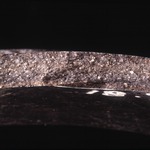
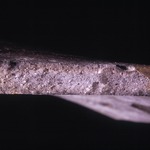
Hard, sandy fabric, varying in colour from dark-grey or black with a brown or reddish brown core and a reddish-brown, blue-grey, black or lighter (‘pearly grey’) surface; very finely burnished with a characteristic ‘silky’ texture; abundant quartz inclusions and some black iron and mica set in a silty matrix. Wheel thrown.
Forms
Everted-rim jars, bowls and dishes. Jars and bowls have a lattice-decorated band across the body and dishes may have a single horizontal wavy line. The detail of form and decorative motifs in the assemblage from the north seems more restricted than that from sites in the south-east.
Chronology
BB2 appears in small quantity below Hadrianic fire levels in London, but no evidence for production much before AD 120 and development of the style in the south-east seems to coincide with the expansion of the distribution of BB1 at that date. The fabric is common throughout the Antonine period.
Source
Colchester, or north Kent.
Distribution
The distribution of this BB2 fabric (as opposed to the other black-burnished wheel-thrown wares which are known to be circulating) in the south-east has not been defined, and is under-recorded on the map, . The general style is abundant in Kent, the London area, Hertfordshire and Essex. In the north BB2 is particularly characteristic of Antonine Wall deposits.
Aliases
Caister-on-sea fabric BB2-102. Carlisle fabric 316. Chelmsford fabric 41. Colchester fabric GB. JRPS bibliography fabric bb2. Old Penrith fabric 44. Kent coarse fabric 4.
Bibliography
Farrar 1973; Williams 1977, group XII. The current state of BB2 studies is discussed by Monaghan 1987, 171-2; Pollard 1988, 87-91. Monaghan lists ‘BB2’ fabrics examined in the north and notes possible sources in the south-east (ibid., 256-7).
References
Farrar 1973. Farrar, R. A. H., ‘The techniques and sources of Romano-British black-burnished ware’ in Current research in Romano-British coarse pottery: papers given at a C.B.A. Conference held at New College, Oxford, March 24 to 26, 1972, ed. A. Detsicas, Research reports/Council for British Archaeology, 10, Council for British Archaeology, London, (1973), pp. 67-103.
Monaghan 1987. Monaghan, J., Upchurch and Thameside Roman pottery. A ceramic typology for northern Kent, first to third centuries A.D., British archaeological reports. British series, 173, Oxford, (1987).
Pollard 1988. Pollard, R. J., The Roman pottery of Kent, Monograph series of the Kent Archaeological Society, 5, Kent Archaeological Society, Maidstone, (1988).
Williams 1977. Williams, D. F., ‘The Romano-British black-burnished industry: an essay on characterization by heavy-mineral analysis’ in Pottery and early commerce. Characterization and trade in Roman and later ceramics, ed. D. P. S. Peacock, Academic Press, London, (1977), pp. 163-220.