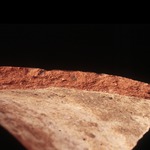
Fabric and technology
Fairly hard, fine-textured, with slightly irregular fracture; red-brown (2.5YR 5/6) with grey core in thicker sherds; inclusions of well-sorted fine sand (containing quartz and feldspar), larger rounded brown clay pellets, and some golden mica (more visible in the surfaces). Wheel-thrown. Three variants:
red slip
cream slip
golden micaceous slip.
Forms
The three fabric variants are employed for different forms:
| Fabric | Form | Description | Cam. |
|---|---|---|---|
| A | P1 | Platter | 1 |
| B | F1 | Flagon | |
| B | F2 | Flagon | |
| B | F3a | Flagon | |
| B | F3b | Flagon | 165 |
| C | J1 | Moulded-rim jar | 102 |
Chronology
Flagon F1 found in early Augustan Welwyn Garden City burial; most other examples pre-Claudian and little evidence of post-conquest importation.
Source
Probably from the middle Loire valley, perhaps the Orléans region where the local assemblage includes a coarser version of the fabric described here, which is not found in Britain (,2).
Distribution
Common in Orléans region, and north into Paris basin; also at Rouen, suggesting trade along the Seine. In Britain, concentrated in two groups, centered on Hampshire and Herts/Essex.
Aliases
Leicester fabric WS1.
Bibliography
Rigby and Freestone 1986; Rigby and Freestone 1988; Tyers (forthcoming) .
References
Rigby and Freestone 1986. Rigby, V. and Freestone, I., ‘The petrology and typology of the earliest identified Central Gaulish imports’, Journal of Roman Pottery Studies, 1, (1986), pp. 6-21.
Rigby and Freestone 1988. Rigby, V. and Freestone, I., ‘The Introduction of Roman styles and techniques into Roman Britain: a case study from the King Harry Lane cemetery St Albans.’ in Materials Issues in Art and Archaeology., ed. E. V. Sayre, Materials Research Society Symposium Proceedings, 123, Materials Research Society, (1988), pp. 109-115.
Tyers (forthcoming). Tyers, P. A., ‘Central Gaulish coarse wares’, forthcoming.