Introduction
The two principal Central Gaulish sigillata producers, Les Martres-de-Veyre and Lezoux (near Clermont-Ferrand) were the main samian exporters to Britain for most of the 2nd cent. The earlier product of Lezoux, in a distinctive micaceous fabric, was also exported in small quantities.
Fabric and technology
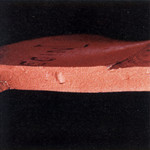
Les Martres-de-Veyre: Very hard, high fired fabric (sherds ring when knocked together) with conchoidal fracture; bright orange-red or red (2.5YR 5/6) with ‘satin’ gloss slip (2.5YR 4/6) on all surfaces, sometimes marred with finger marks and other blemishes near rim and base; abundant very fine limestone flecks (visible under x20 lens), with sparser red iron ore, quartz and a little mica.
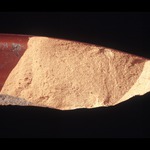
Micaceous Lezoux ware: Slightly laminar fracture, often with numerous horizontal voids; reddish-yellow (5YR 5/6 to 5YR 6/3) with porous red or reddish-brown slip (e.g 2.5YR 3/6 or 5/6) which may appear thin; distinctive abundant fine mica, with some fine quartz sand, red iron ores and rounded limestone particles. Plain wares normally fairly hard fired, but decorated ware tends to be softer with flaking slip – Dannell’s description as ‘mica filled digestive biscuit’ (1977, 231) is particularly apt.
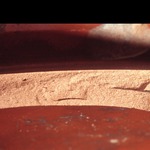
Standard Lezoux fabric: Hard fabric with finely irregular fracture; brown or orange-brown (2.5YR 4/8 or 4/6) matrix and relatively dull slip; some fine mica visible in matrix (but significantly less than in the earlier fabric), with fine quartz sand, sparse limestone and red iron ores.
Chronology
Production at Lezoux commences in Augustan-Tiberian period and micaceous Lezoux fabric exported to Britain between c. AD 50-120; main phase of production from c. AD 120 until later 2nd cent. Significant export from Les Martres-de-Veyre almost confined to AD 100-25, with exception of potter Cettus (c. AD 135-65).
Distribution
Early Lezoux wares are common in 1st cent. AD assemblages along the Loire and in Brittany; thence to Britain, where more common in south and west (Boon 1967; Dannell in Peacock 1971, 266-7). Martres and later Lezoux wares have wide distribution through northern and eastern Gaul, the Rhineland, and into Danube provinces; in Britain, abundant throughout (Hartley 1972, 28).
Aliases
Colchester fabric CG/LZ. JRPS bibliography fabric cts. Milton Keynes fabric . Kent fine fabric 3d. Silchester fabric E4.
Bibliography
Bémont and Jacob 1986, 137-64, with refs. Lezoux production summarized in: Bet et al. 1987; for decorated wares: Stanfield and Simpson 1958 revised as Stanfield and Simpson 1990; Terrisse 1968; Rogers 1974;, for figure types: Déchelette 1904; Oswald 1936; for dating of major potters, particularly Cinnamus: Hartley 1972; Simpson and Rogers 1969; for an alternative view see King 1981.
References
Bémont and Jacob 1986. Bémont, C. and Jacob, J.-P., La Terre sigillée gallo-romaine. Lieux de production du Haut Empire: implantations, produits, relations, Documents d’archéologie française, 6, Maison des Sciences de l’Homme, Paris, (1986).
Bet et al. 1987. Bet, P., Gangloff, R. and Vertet, H., Les productions céramiques antiques de Lezoux et de la Gaule centrale à travers les collections du Musée archéologique de Lezoux (63), Revue archéologique SITES. Hors-série, 32, (1987).
Boon 1967. Boon, G. C., ‘Micaceous sigillata from Lezoux at Silchester, Caerleon and other sites’, AntJ, 47, (1967), pp. 27-42.
Dannell 1977. Dannell, G. B., ‘The samian from Bagendon’ in Roman pottery studies in Britain and beyond Papers presented to J. P. Gillam, July 1977, ed. J. Dore and K. T. Greene, British archaeological reports. International series, 30, BAR, Oxford, (1977), pp. 229-35.
Déchelette 1904. Déchelette, J., Les vases céramiques ornés de la Gaule romaine, Paris, (1904).
Hartley 1972. Hartley, B. R., ‘The Roman occupation of Scotland. The evidence of samian ware’, Britannia, 3, (1972), pp. 1-55.
King 1981. King, A., ‘The decline of samian manufacture in the north-west provinces: problems of chronology and interpretation’ in The Roman West in the third century. Contributions from archaeology and history, ed. A. King and M. Henig, British archaeological reports. International series, 109, BAR, Oxford, (1981), pp. 55-78.
Oswald 1936. Oswald, F., Index of figure-types on terra sigillata, University Press, Liverpool, (1936-7).
Peacock 1971. Peacock, D. P. S., ‘Petrography of certain coarse pottery’ in Excavations at Fishbourne, 1961-69, ed. B. Cunliffe, 27, Reports of the research Committee of the Society of Antiquaries of London, London, (1971), pp. 255-259.
Rogers 1974. Rogers, G. B., Poteries sigillées de la Gaule centrale, Supplément à Gallia, 28, Éditions du CNRS, Paris, (1974).
Simpson and Rogers 1969. Simpson, G. and Rogers, G., ‘Cinnamus de Lezoux et quelques potiers contemporains’, Gallia, 27, (1969), pp. 3-14.
Stanfield and Simpson 1958. Stanfield, J. A. and Simpson, G., Central Gaulish Potters, Oxford University Press, London, (1958).
Stanfield and Simpson 1990. Stanfield, J. A. and Simpson, G., Les potiers de la Gaule centrale, Revue Archéologie Sites, Gonfaron, (1990).
Terrisse 1968. Terrisse, J. R., Les Céramiques sigillées gallo-romaines des Martres-de-Veyre (Puy-de-Dome), Supplément à Gallia, 19, Éditions du CNRS, Paris, (1968).