Fabric and technology
Three distinctive fabrics:
Grey ware: a hard fine-textured fabric; very pale grey core (sometimes almost white) with medium grey surfaces; abundant inclusions of fine quartz sand. Frequent smooth wheel-burnishing on surfaces. Wheel-thrown.
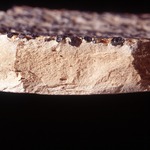
‘Parchment’ ware: a variable group of hard, brittle, white, buff (through to yellow or orange) fabrics with a laminar fracture; abundant fine sand tempering. Frequent orange or brown painted decoration. Iron slag grits on the mortaria.
Red ware: soft fabric with orange core and burnished orange-red surfaces; variable quantities of sand and soft red-brown inclusions.
Forms
The principal forms are classified by Corder (1937):
| Type | Description | Fabric |
|---|---|---|
| 1 | flanged bowl | G |
| 2 | shallow sided dish | G |
| 3 | jar with 2 countersunk handles | G |
| 4 | deep wide-mouthed bowl | G |
| 5 | hemispherical flanged bowl | GPR |
| 6 | hammerhead mortarium | P |
| 7 | wall-sided mortarium | P |
| 8 | wall-sided mortarium | |
| - with double flanged rim | P | |
| 9 | small bowl with upright rim | P |
| 10 | large dish | P |
| 11 | small jar/beaker | G |
| 12 | beaker | G |
| 13 | small bowl.G | |
| 14 | bottle or flagon | G |
| 15 | jug with pinched spout | G |
| 16 | calcite-gritted cooking pot |
Table 1. Classification of Crambeck ware forms (after Corder)
Fabric codes: G=grey, P=parchment, R=red.
Chronology
Production commences by early 4th cent. and continues until end of Roman period. Major expansion from mid-4th cent.
Source
Crambeck (Yorks), which is on the south side of the Howardian Hills, overlooking the Vale of York.
Distribution
The grey ware is the most abundant Crambeck fabric, but both ‘parchment’ and red ware are found in smaller quantities. Distributed across north-east England during the early to mid-4th cent., but principal market is Malton-York region. Increasing penetration of markets in north-west from c. AD 360-70. Small quantities as far as Caernarfon (N. Wales), but distribution to south of Crambeck always restricted. Evans (in Wilson 1989) discusses Crambeck distribution pattern and rehearses arguments for military contracts and social constraints.
Aliases
Carlisle fabrics 101 and 105. JRPS bibliography fabric cra.
Bibliography
(Wilson 1989) collects together original reports on the kilns. RCHM gazetteer F693-8
References
Corder 1937. Corder, P., ‘A pair of fourth century Romano-British pottery kilns near Crambeck’, AntJ, 17, (1937), pp. 392-413.
Wilson 1989. Wilson, P. R., (ed), Crambeck Roman Pottery Industry, The Roman Antiquities Section, Yorkshire Archaeological Society, Leeds, (1989).