Fabric and technology
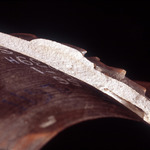
A hard, smooth-textured (but occasionally slightly laminar) fabric, containing sparse fine inclusions of colourless quartz, black and red iron and rare fine white mica; almost pure white (2.5YR 9/0) in colour, with a dark brown or black matt colour-coat (2.5YR 2.5/0) merging (where the slip is thinner) to a lighter orange-brown. The slip contains minute flakes of red and black iron oxide particles. Wheel thrown. Principal decorative motifs are roughcasting (with clay particles), barbotine (including hunt-cups) and rouletting. The barbotine is made of the same clay as the body.
This ware equates with Anderson’s (1980) Lower Rhineland fabric 1 and is known colloquially as ‘Cologne ware’ in Britain. The principal differences between this and Central Gaulish colour-coated white ware (CGCC) are its matt slip, slightly softer, more silty texture and lack of mica.
Forms
Principally beakers:
| Type | Form | |
|---|---|---|
| 1-2 | 1 | High shouldered |
| 12 | 2 | Bag-shaped |
| 3-6 | 3 | Globular (high curved neck) |
| 7-11 - | 4 5 | Globular (everted rim) Multiple grooved neck |
Table 1. Classification of Lower Rhineland colour-coated ware forms (after Anderson)
Chronology
Production commences in the Claudian period. Cups and beakers with barbotine and roughcast decoration (some in a white fabric similar to that described above) are found along the Rhine (and rarely in Britain) during the Claudio-Neronian period (Greene 1979, 56-64). From the Flavian period production concentrated on beakers and this tradition continued to the mid-3rd cent. AD.
Source
Cologne is a major source, where kilns are known (Binsfeld 1964).
Distribution
Principally the Rhineland and Britain (Anderson 1981, 338, fig.19.4). There is some risk of confusion between the products of Cologne and those of the Nene Valley and Colchester in the hand-specimen, although they may be discriminated with chemical analysis. The distribution is likely to be incomplete due to uncertain identification. Lower Rhineland potters were responsible for the development of the colour-coated industries in the Lower Nene Valley and Colchester from the early 2nd cent. AD.
Aliases
Carlisle fabric 318. Chelmsford fabric 6. Gestingthorpe fabric B6. JRPS bibliography fabric kww. Lullingstone fabric 2. Milton Keynes fabric 23b. Kent fine fabric 5b. Towcester fabric 14c.
Bibliography
Anderson 1980; Anderson 1981. Chemical analysis: Anderson et al. 1982.
References
Anderson 1980. Anderson, A. C., A guide to Roman fine wares, Vorda Research Series, 1, Vorda, Highworth, (1980).
Anderson 1981. Anderson, A. C., ‘Some continental beakers of the first and second centuries A.D.’ in Roman Pottery research in Britain and North-West Europe. Papers presented to Graham Webster, ed. A. C. Anderson and A. S. Anderson, British archaeological reports. International series, 123, BAR, Oxford, (1981), pp. 321-48.
Anderson et al. 1982. Anderson, A. C., Fulford, M. G., Hatcher, H. and Pollard, A. M., ‘Chemical Analysis of Hunt Cups and Allied Wares from Britain’, Britannia, 13, (1982), pp. 229-38.
Binsfeld 1964. Binsfeld, W., ‘Zu den römischen Töpfereinen am Rudolfplatz in Köln’, KölnJbVFrühGesch, 7, (1964), pp. 19-32.
Greene 1979. Greene, K. T., The pre-Flavian fine wares, Report on the excavations at Usk, 1965-1976, 1, University of Wales Press [for] the Board of Celtic Studies of the University of Wales,, Cardiff:, (1979).