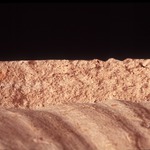
Fabric and technology
A very hard smooth-textured creamy-buff or pink fabric (7.5YR 8/4 to 2.5YR 6/8) perhaps with a grey or orange core, with sparse coarse inclusions of irregular brown clay pellets, glassy quartz and occasional black (volcanic?) grains. Wheel-thrown. The mottled matt slip is normally a shade of orange or red (10R 6/6 to 5/8) but may be lighter (buff) or a darker brownish-black colour; the marbling shows no clear patterning and the slip is often harsh to the touch. Some vessels have white roundels or other motifs (including simple inscriptions) overpainted on the shoulder. In German reports this is described to as marmorierte keramik/
Forms
The principal forms in the ware are flagons:
a two-handled vessel with a collar on the neck.
a one-handled jug with grooves on the body.
a one-handled round-bodied flagon with offset at the shoulder.
Chronology
Early or mid-3rd to late 4th cent.
Source
The middle Rhine or lower Mosel valleys (Oelmann 1914, 50). A second marbled fabric from kilns at Speicher and Trier and described as flamed (/ ware is distributed in the Trier area and north into the Ardennes and Belgium; this is not found in Britain.
Distribution
The middle and lower Rhine (from Mainz to Nijmegan), Kent and the London area.
Aliases
Colchester fabric EESJ. Lullingstone fabrics 8 and 9. Kent fine fabric 5e.
Bibliography
The principal studies of the origin, dating and distribution of the ware are the reports on the Trier Kaiserthermen and Niederbieber (Hussong and Cüppers 1972; Oelmann 1914). The British evidence is described by Bird and Williams (1982) with a report on the petrology.
References
AML 3824 1982. Bird, J. and Williams, D., German marbled flagons in Roman Britain, 3824, English Heritage, London, (1982).
Hussong and Cüppers 1972. Hussong, L. and Cüppers, H., Die Trierer Kaiserthermen. Die spätrömische und frühmittelalterliche Keramik, Trieren Grabungen und Forschungen, 1, P. von Zabern, Mainz am Rhein, (1972).
Oelmann 1914. Oelmann, F., Die Keramik des Kastells Niederbieber, Materialien zur römisch-germanischen Keramik, 1, (1914).