Fabric and technology
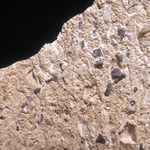
Hard, granular fabric, which is rough to the touch but with a slightly laminar fracture; usually white or cream (e.g. 2.5YR 5/0 to 9/0 or 10YR 9/1) but sometimes more orange or buff, with pink or black core in thickest parts. Characteristic abundant inclusions of well-sorted quartz with sparser red ironstone inclusions set in a fine matrix. Gritted on the interior, and over the flange on some, with flint and coarse quartz.
For other products of the Verulamium-region industries see VRW.
Forms
Mortaria. A wide variety of rim forms occur, and some variants can be assigned to individual potters or workshops. There is a progression from forms with a deeply hooked flange, through to those with a higher bead and shorter flange. Gillam 240.
Stamps
Often stamped, sometimes with a name stamp on one side of the flange and a counterstamp (e.g. FECIT) on the other. Stamps of over 50 named potters are known, and there are additional illiterate stamps or marks. Some potters are represented by many hundreds of specimens (e.g. Albinus – the most prolific, Matugenus, Doinus) while others by only a single example, perhaps only from one of the known kiln sites. The counterstamps of three potters (Albinus, Oastrius, Q. Rutilius Ripanus) record a place name, LUGDUNUM or LUGUDUNUM, which may refer to Bricket Wood (Herts).
| Potter | Date | |
|---|---|---|
| ALBANUS | 60-90 | |
| ALBINUS | 60-90 | <- COMO? |
| LUGDUNUM potter | ||
| BRUC[C]IUS | 80-120 | |
| CANDIDUS | 90-125 | |
| CASTUS | 100-140 | |
| DEVALUS | 70-100 | |
| DOCCAS | 85-110 | -> MHMO |
| DOINUS | 70-110 | |
| DRICCIUS | 100-145 | |
| G. ATTIUS MARINUS | 100-110 | <- COMO -> MHMO |
| GISSUS | 90-140 | |
| JUNIUS | 100-140 | |
| L. ARRIUS CALUDUS | 65-95 | |
| LALLAIUS | 80-125 | |
| MARINUS | 80-125 | |
| MARTINUS | 100-140 | |
| MATUGENUS | 80-125 | Son of ALBINUS |
| MELUS i | 95-135 | |
| MERTUCUS | 110-150 | |
| MORICAMULUS | 70-110 | |
| MORINA | 70-130 | |
| NIDUS | 100-120 | -> MHMO |
| NSRO | 120-145 | |
| OASTRIUS | 55-80 | LUGDUNUM potter |
| OVIDUS | 110-140 | |
| Q. RUTILIUS RIPANUS | 55-90 | LUGDUNUM potter |
| RAMOTUS | 65-95 | |
| ROA | 110-140 | |
| S. VALERIUS IV.. | 55-90 | <- COMO |
| SATURNINUS i | 105-140 | |
| SECUNDUS | 55-90 | |
| SOLLUS | 60-100 | |
| TMH | 120-145 | <- COMO |
| VIDEX | 85-140 |
Some VRMO potters migrated to the region from elsewhere, principally Colchester (G. Attius Marinus, T.M.H, possibly Sex. Valerius Iu.., Aprilis, Severus and Albinus), and some later moved away to set up workshops in the Mancetter-Hartshill complex (G. Attius Marinus again, Doccas and Nidus). Family potting traditions are indicated by Matugenus, who records that he is the son of Albinus on some stamps.
An interesting sidelight on mortarium production in the Verulamium-region is provided by a few specimens in this ware stamped with dies that were used more commonly as official tile-stamps. These read P.P.BR.LON or P.PR.BR, which can be interpreted as p(rocuratores) p(rovinciae) Bri(tanniae) [Lon(dini)] – ‘The procurators of the province of Britain [at London]’ (/ 2485; Collingwood et al. 1993, 30).
Chronology
Production commenced before the Boudiccan revolt (c. AD 50/55), and mortaria were stamped until c. AD 155/160. Production continues on a smaller local scale until c. AD 200.
Source
Between St Albans (Verulamium) and London, near Watling Street. Kilns known at Brockley Hill, Radlett, Bricket Wood and on the outskirts of Verulamium itself.
Distribution
Mortaria have a wide, distribution across Britain, including Scottish forts and the Hadrianic frontier, but largest concentrations are at London and St Albans, each with many hundreds of stamps (see ).
Aliases
Caersws mortarium fabric 1. Caister-on-sea fabric VERUL. Carlisle fabrics 620 and 621. Chesterfield fabrics m3, m4 and m5. Chichester mortarium fabric 4. Cirencester fabric 72. Colchester fabric TD. Doncaster mortarium fabric 12. Exeter mortarium fabric FB34. Gestingthorpe mortarium fabric J. Gloucester fabric TF9F. Great Chesterford mortarium fabrics 3-5. JRPS bibliography fabric vrm. Leicester fabrics MO7 and MO10. Milton Keynes fabric 4g. Old Penrith fabric 108. Kent mortarium fabric 1. Sheepen mortarium fabric 28. Sidbury fabric 35. Towcester mortarium fabric 5. Usk mortarium fabric 18.
Bibliography
For the kiln sites: RCHM gazetteer 97-8, F354-5, F359-62, F475-80; summary of the industry in Marsh and Tyers 1978. There is no complete published catalogue of stamps, but the most common are reported in the large collection from Verulamium (Hartley 1984). For the LUGDUNUM group: Saunders and Havercroft 1977.
References
Collingwood et al. 1993. Collingwood, R. G., Wright, R. P., Frere, S. S. and Tomlin, R. S. O., The Roman Inscriptions of Britain. Volume II, Fascicule 5, Alan Sutton Publishing, Stroud, (1993).
Hartley 1984. Hartley, K. F., ‘The mortarium stamps’ in Verulamium Excavations Volume III, ed. S. S. Frere, Oxford University Committee for Archaeology. Monograph, 1, Oxford, (1984), pp. 280-91.
Marsh and Tyers 1978. Marsh, G. D. and Tyers, P. A., ‘The Roman Pottery from Southwark’ in Southwark Excavations 1972-74, ed. J. Bird, A. H. Graham, H. L. Sheldon and P. Townend, Joint Publication (London and Middlesex Archaeological Society and Surrey Archaeological Society), 1, London, (1978), pp. 530-607.
Saunders and Havercroft 1977. Saunders, C. and Havercroft, A. B., ‘A kiln of the potter Oastrius and related excavations at Little Munden Farm Bricket Wood’, HertsArch, 5, (1977), pp. 109-56.