Fabric and technology
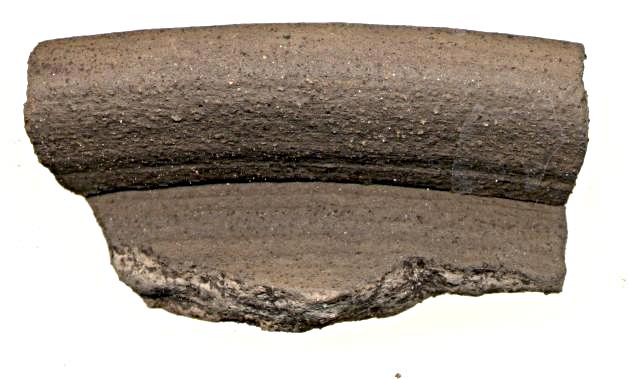
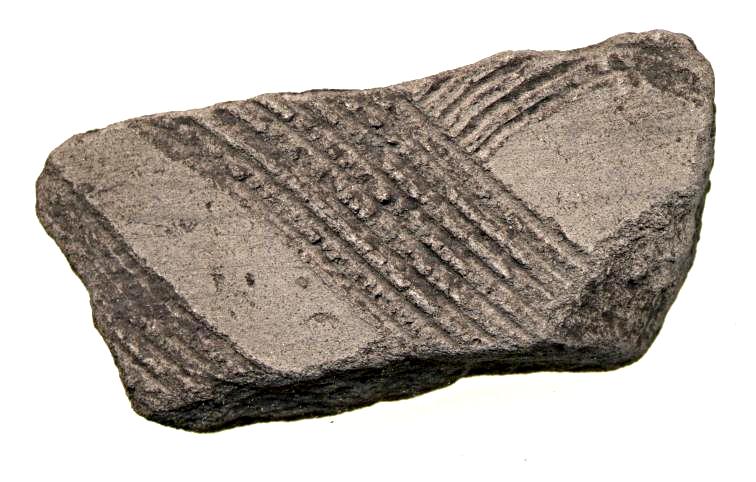
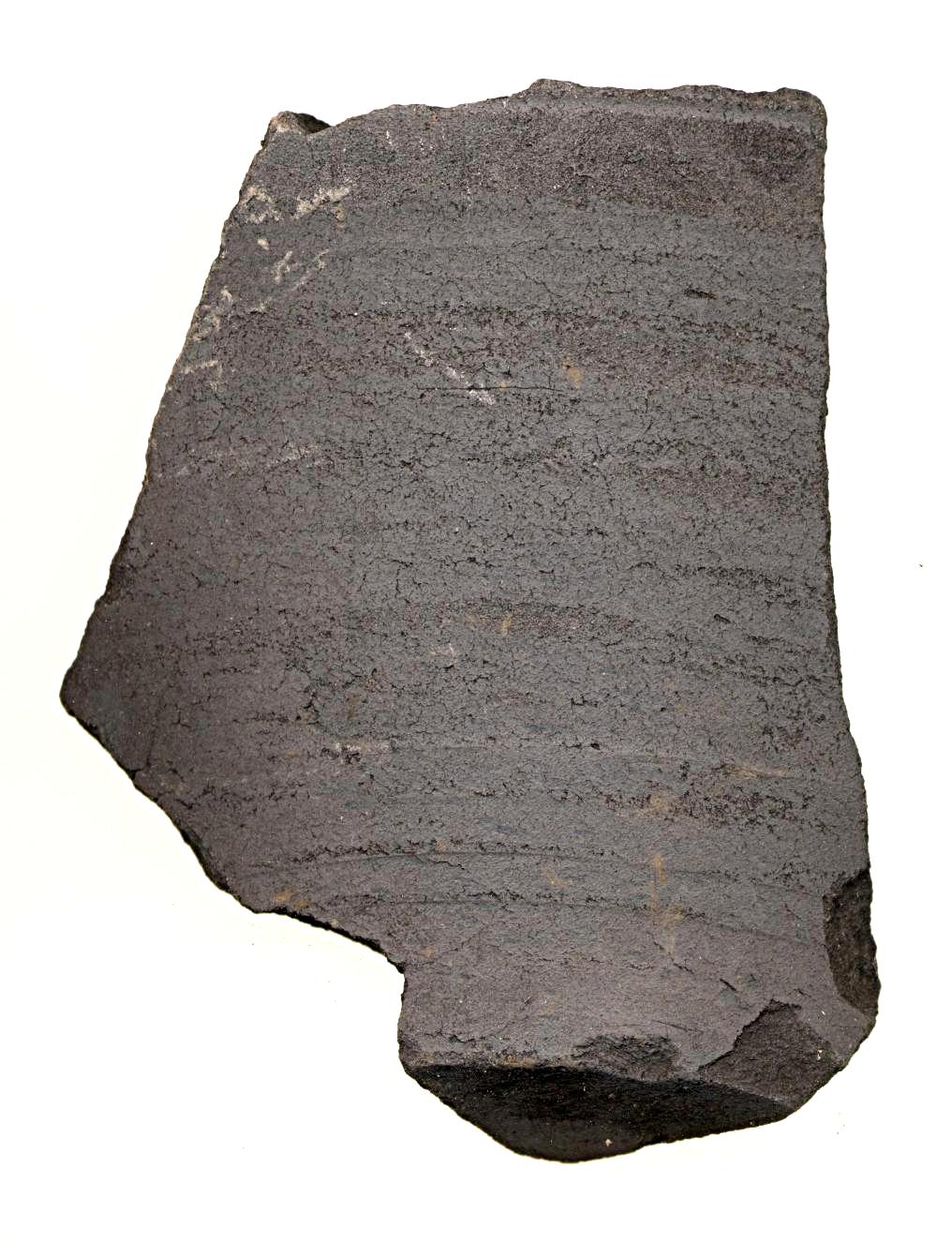
Earlier fabrics are hard and rough in texture, with brittle irregular fracture; light grey (Munsell e.g. 2.5YR 5/0-6/0) with darker margins and surfaces (Munsell 2.5YR 2/0-3/0) or may be darker grey throughout; abundant well-sorted quartz (multicoloured, white and glassy), some fine mica and occasional larger rounded flint inclusions in a silty clay matrix. A rarer variety, with coarse sand temper, is typical of large bead-rim jars. Surfaces burnished externally (and internally on open forms), sometimes in horizontal zones, producing slightly metallic sheen. From the later 3rd cent. fabrics tend to be hard, dense and smooth textured, decorated with zones of burnishing and combed wavy lines, and zones of slate-grey, white or black slip.
Typology
The earlier assemblage is dominated by necked jars with a carinated shoulder, bead-rim jars and distinctive bowls with moulded lip and cordon or offset half-way down the outer wall (known as ‘Surrey bowls’ or ‘Atrebatic bowls’). From the 3rd cent. flanged bowls, dishes and everted-rim jars derived from BB1 prototypes were produced, alongside single-handled jugs and a range of other jar forms.
| Fig. | Class | Form |
|---|---|---|
| 5, 8 | 1 | cordoned jars |
| 12 | 1A | narrow-necked cordoned jars |
| - | 1B | flasks |
| - | 1C | large cordoned storage jars |
| - | 2 | pedestal jars |
| - | 3 | flat or everted rim jars |
| - | 3A | flat-rimmed jars |
| 9-11 | 3B | everted-rim/cavetto-rim jars |
| - | 3C | triangular/hooked rim jars |
| 3-4 | 4 | bead-rim jars |
| 2 | 5 | bowls |
| - | 5A | triangular rim bowls |
| 15-16 | 5B | flanged bowls |
| 17 | 5C | strainers |
| - | 5D | deep decorated bowls |
| - | 5E | large reed-rim bowls |
| - | 6 | platters |
| 13-14 | 6A | straight-sided dishes |
| - | 6B | triangular rim dishes |
| - | 6C | bead and flanged dishes |
| - | 7 | lids |
| 1, 6-7 | 8 | flagons |
| - | 9 | storage jars |
Date
Production commences by c. AD 50/60 and continues through to end of 4th cent. Chronology of some individual types is disputed, particularly during 3rd cent.
Source
The Alice Holt/Farnham region, in the Wey Valley on the Surrey-Hampshire border. There is a concentration of c. 80 kilns and waster dumps in an area 2km x 3km in the southern Alice Holt Forest.
Distribution
A major supplier to the London region, Surrey, Hampshire and north Sussex, during the 1st and early 2nd cent., with outliers in the west, as far as Usk and Exeter. Decline from mid-2nd to later 3rd cent. but increased from c. AD 270 to be a major supplier throughout central-southern England and the London region. Occasional examples from beyond, particularly in later 4th-cent. levels.
Aliases
References
Lyne and Jefferies 1979 is the principal recent study of the industry; for kilns: RCHM gazeteer F309-21, F623-8.
An alternative view of dating of some types, based on the data from local small town of Neatham, is given by Millet 1979.
Notes
A coarse buff gritty fabric with a rilled surface, Portchester fabric D, was produced in the same region during the 4th cent.
The later Alice Holt fabrics cannot always reliably be distinguished from New Forest grey wares and other fine grey fabrics in southern Britain.
The migration of Alice Holt potters to (at least) East Kent and West Sussex during the mid-4th cent. has been postulated on the evidence of both pottery form and the distinctive double-flue kiln structures of the industry (Pollard 1988, 191, with refs.). Forms resembling the earlier Alice Holt styles in the London region, but apparently in different wares, may suggest satellite producers during the 1st-2nd cent.
See also
Bibliography
Lyne and Jefferies 1979 M. A. B. Lyne and R. S. Jefferies, The Alice Holt/Farnham Roman pottery industry, Research reports/Council for British Archaeology 30 London: Council for British Archaeology (1979).
Millet 1979 M. Millet, ‘The dating of Farnham (Alice Holt) pottery’, Britannia 10 1979 pp.121-37.
Pollard 1988 R. J. Pollard The Roman pottery of Kent Monograph series of the Kent Archaeological Society 5 Maidstone: Kent Archaeological Society (1988).