Fabric and technology
Hard, fine-textured buff or pink ware, often with large white inclusions visible.
Forms
Two handled vessel with globular body, conical neck and everted rim; upper part of body covered with a band of horizontal grooves.
Chronology
From 5th to early 7th c. AD.
Source
The Aegean area, perhaps Chios.
Distribution
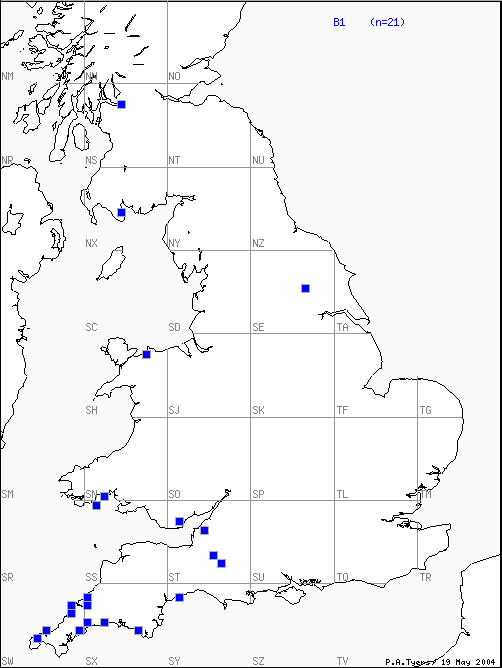
Wide distribution around the eastern Mediterranean; rare in northern Europe but some examples on post-Roman sites in Western Britain.
Aliases
Keay fabric 21. Keay class LXV. Peacock and Williams class 43 (Scorpan 7A, Carthage LR2, Benghazi LR2, Keay LXV).
Bibliography
General: Tomber and Williams 1986. Distribution: Thomas 1981; Riley 1979; Reynolds 1995, 71-83; Pieri 1998)
References
Pieri 1998. Pieri, D., ‘les importations d’amphores oreintales en Gaule méridionale durant l’Antiquité tardive et le Haut Moyen Age (IVe-VIIe siècles après J.-C.). Typologie, chronologie et contenu’ in Actes du Congrès d’Istres. 21-24 mai 1998. Société Française d’tude de la Céramique Antique, ed. L. Rivet, SFECAG, Marseille, (1998), pp. 97-106.
Reynolds 1995. Reynolds, P., Trade in the Western Mediterranean, AD 400-700: The ceramic aevidence, BAR International Series, 604, Tempvs Reparatvm, Oxford, (1995).
Riley 1979. Riley, J. A., ‘The coarse pottery from Benghazi’ in Excavations at Sidi Khrebish, Benghazi (Berenice). II, ed. J. A. Lloyd, Supplements to Libya Antiqua, 5, Department of Antiquities, Tripoli, (1979), pp. 91-497.
Thomas 1981. Thomas, C., A provisional list of imported pottery in Post-Roman Britain and Ireland, Special report, 7, Institute of Cornish Studies, Redruth, (1981).
Tomber and Williams 1986. Tomber, R. and Williams, D. F., ‘Late Roman amphorae in Britain’, Journal of Roman Pottery Studies, 1, (1986), pp. 42-54.