Introduction
Mortaria were produced at Colchester from c. AD 50/55, but until the mid-2nd cent. the industry was relatively small scale. Some Colchester potters moved to the Verulamium region during the 1st cent. (see VRMO). From c. AD 140 production expanded, influenced by potters from the Rhineland who developed colour-coated and sigillata in the same workshops. Only the 2nd cent. Colchester mortaria are considered here.
Fabric and technology
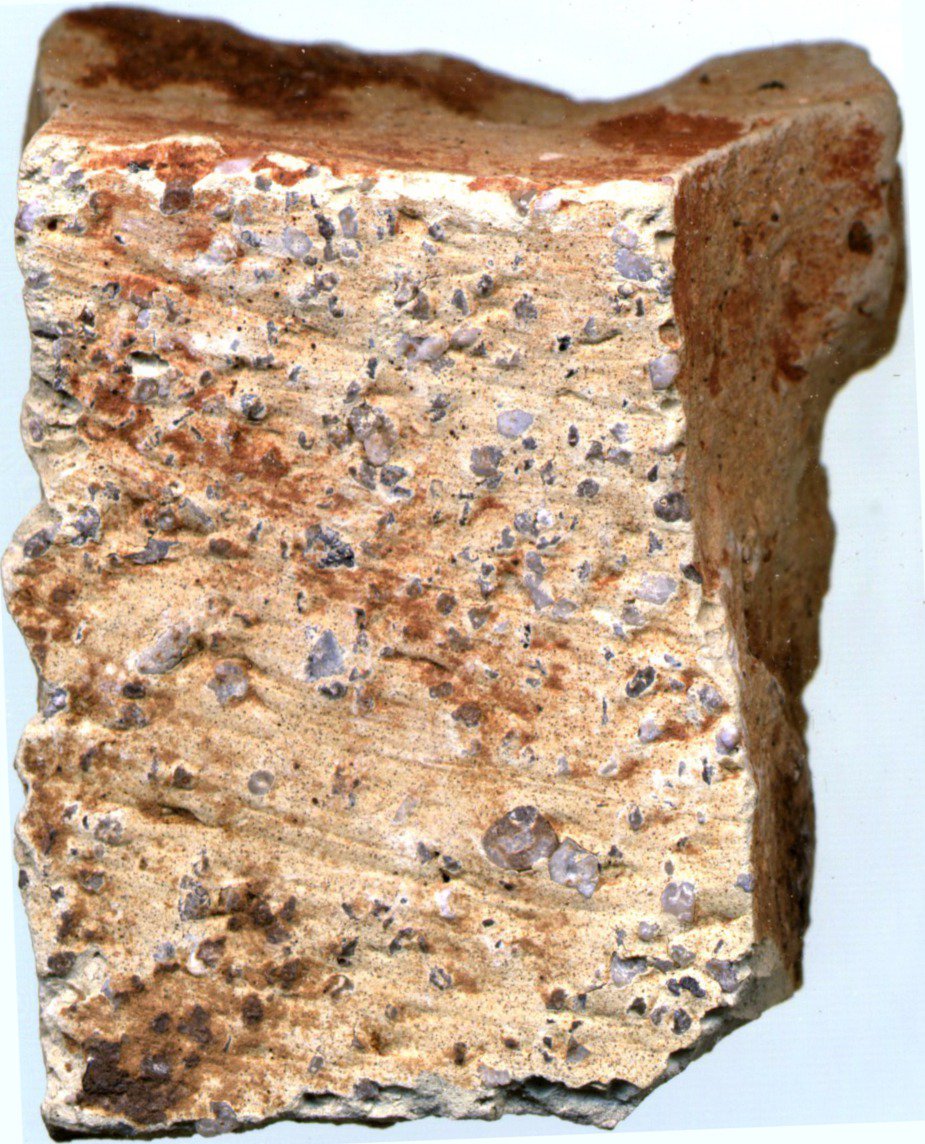
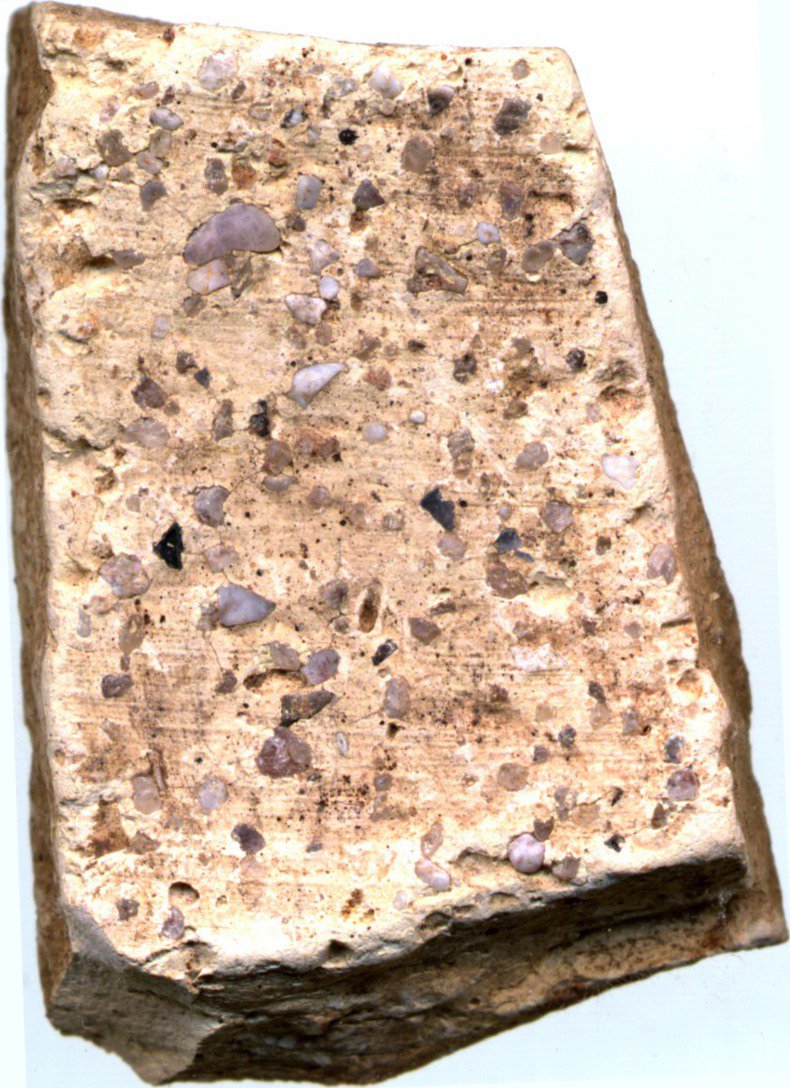
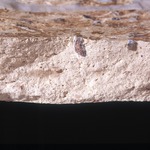
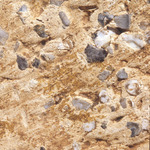
Fine textured cream or creamy-yellow fabric with some fine quartz, flint and red-brown ironstone tempering; gritted with quartz and flint.
Forms
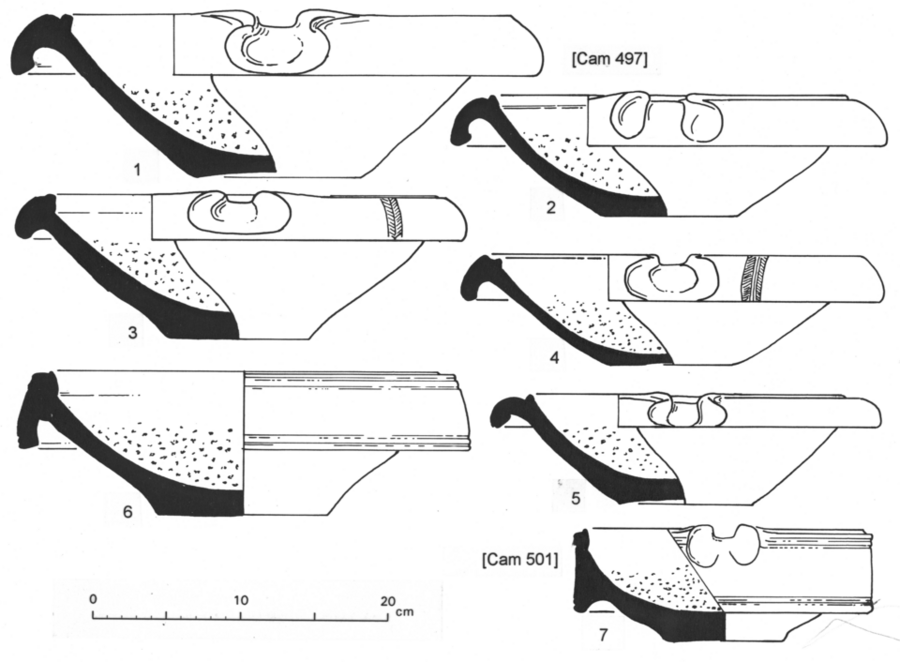
Mortaria; several varieties, including hooked flange, deep vertical flange and short stubby flange with a narrow bead (e.g. Colchester forms 497, 498, 501. Gillam 263, 265).
Stamps
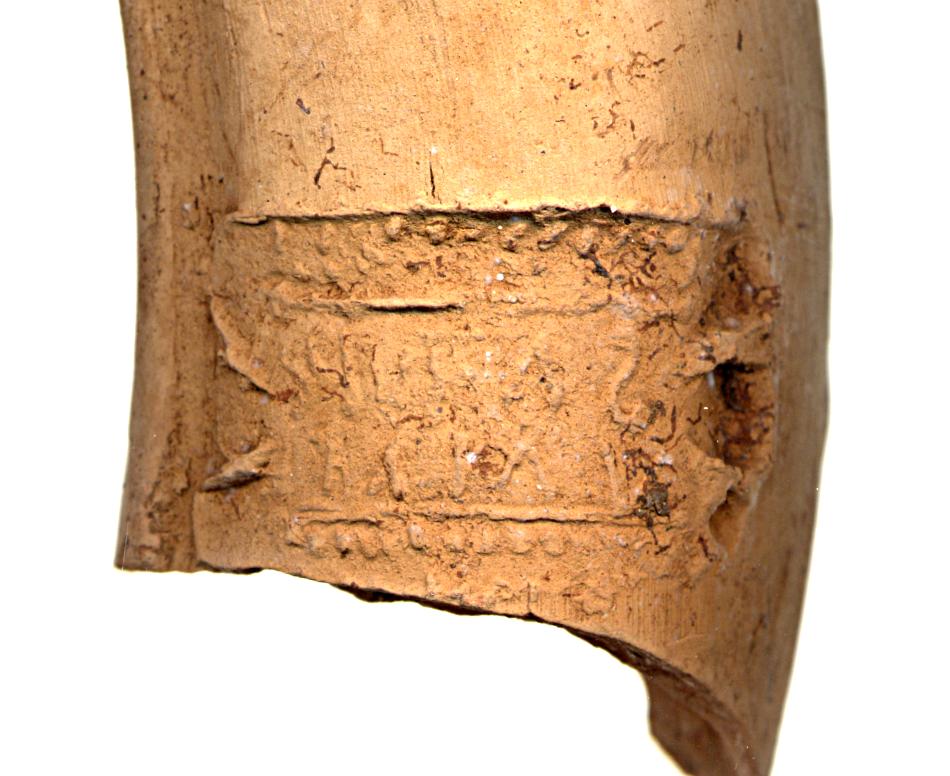
Several named potters; also herringbone stamps, which are particularly characteristic of Colchester mortaria.
| Potter | Date | |
|---|---|---|
| ACCEPTUS | 140-190 | also stamped COTS |
| AMMINUS | 140-190 | |
| BARO | 140-190 | -> RBMO? |
| CUNOPECTUS | 160-200 | also stamped COTS |
| DUBITATUS | 140-180 | |
| LITUGENUS | 140-180 | |
| MARIAUS | 140-190 | |
| MARTINUS | 140-190 | |
| MESSOR | 140-180 | |
| REGALIS | 160-200 | <-> Ellingham (Norfolk) |
Table 1. Principal Colchester mortarium potters, AD 140-200
Chronology
AD 140-200; the herringbone stamps generally AD 140-170/180
Source
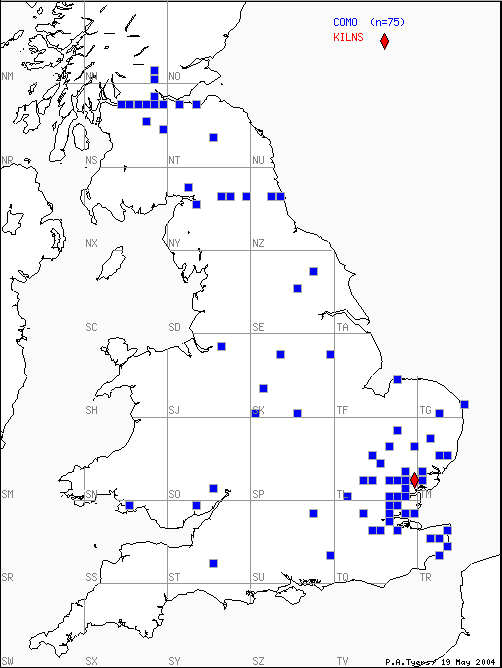
Principally Colchester, but similar fabrics also produced elsewhere in East Anglia and perhaps Kent. One Colchester potter Regalis, also had workshops at Ellingham (Norfolk) and two, Cunopectus and Acceptus, stamped both mortaria and sigillata at Colchester.
Distribution
South-east England (East Anglia and Kent), northern England and Scotland. Colchester was a major supplier to forts on the Antonine frontier (55% at Rough Castle; 45% at Inveresk).
Aliases
Caister-on-sea fabric COLCH. Chesterfield fabrics m14 and m15. Colchester fabric TZ. Gestingthorpe mortarium fabrics A-G. Great Chesterford mortarium fabrics 14-15. JRPS bibliography fabric clm. Rough Castle mortarium fabric 2.
Bibliography
On the kilns Hull 1963;: RCHM gazetteer 92-5, F273-88; for overall distribution Hartley 1973;: for Scottish distribution: Hartley in MacIvor et al. 1981, 261-6.
References
Hartley 1973. Hartley, K. F., ‘The marketing and distribution of mortaria’ in Current research in Romano-British coarse pottery: papers given at a C.B.A. Conference held at New College, Oxford, March 24 to 26, 1972, ed. A. Detsicas, Research reports/Council for British Archaeology, 10, Council for British Archaeology, London, (1973), pp. 35-91.
Hull 1963. Hull, M. R., The Roman potters’ kilns of Colchester, Reports of the Research Committee of the Society of Antiquaries of London, 21, Society of Antiquaries and the Corporation of the Borough of Colchester, Oxford, (1963).
MacIvor et al. 1981. MacIvor, I., Thomas, M. C. and Breeze, D. J., ‘Excavations on the Antonine Wall fort of Rough Castle, Stirlingshire, 1957-61’, PSAS, 110, (1981), pp. 230-85.