Introduction
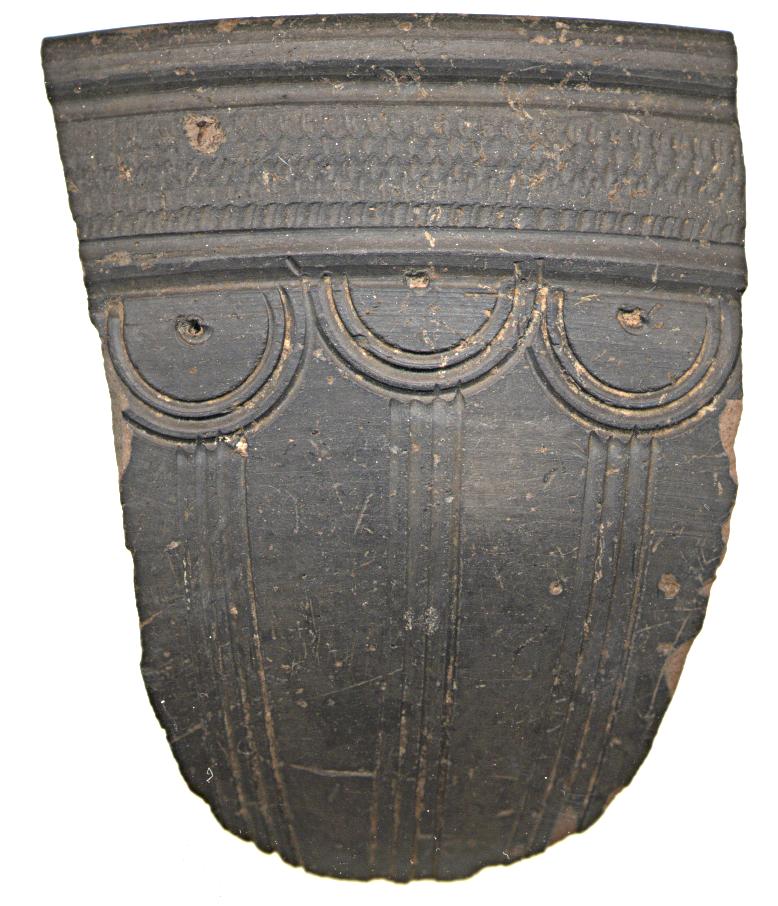
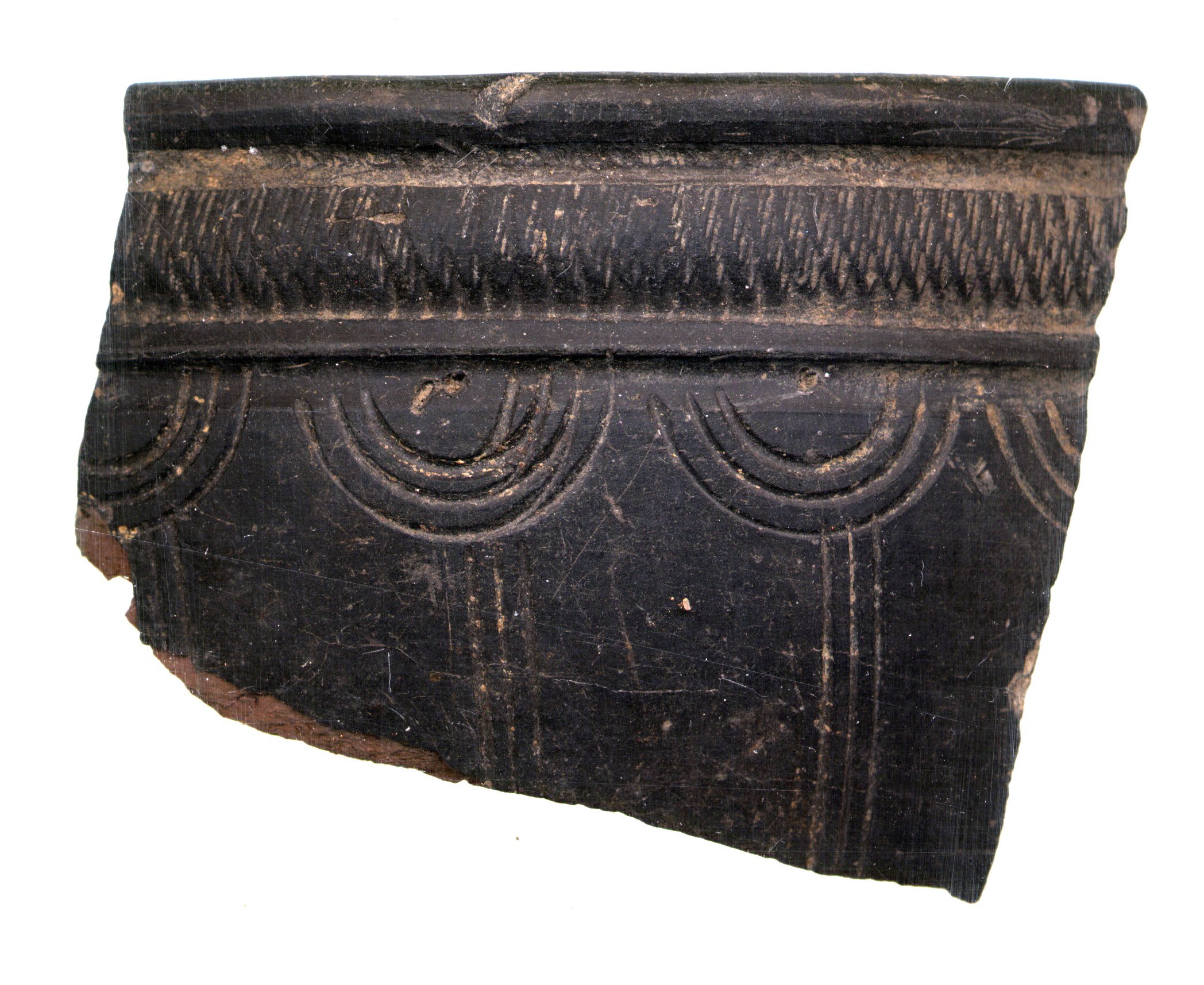
The ‘London ware’ style is characterized by incised (including compass-drawn), rouletted and stamped decoration, generally on fine grey or black fabrics and in forms (principally bowls) which loosely follow samian prototypes. Several sources are represented in the group, which is a style rather than a single ware.
Fabric and technology
The London material (the most extensively studied) is typically a hard, fine smooth-textured micaceous fabric, with a slightly laminar fracture; dark grey-brown core with dark-grey or black slip on finely burnished surfaces.
Forms
Bowls are the most common forms (often following the samian prototypes, Drag. 37, 29 and 30), but beakers, flasks and plates are known in the same fabrics. The range of ‘London ware’ from London published by Marsh (1978) is particularly extensive:
| Form | Description | Prototype | |
|---|---|---|---|
| - - - - - | 17 18 22 28 29 | Carinated beaker Beaker with bulbous body Plain everted rim beaker Dish with beaded lip Dish with beaded rim | |
| 12 - - | 31 34 37 | Dish with flanged rim Dish with curved flange Deep bowl with vertical flange | |
| 1-2 4-5 7-8 | 42 | Hemispherical bowl | Drag. 37 |
| 3 9 - | 44 46 | Carinated bowl Carinated strainer bowl | Drag. 29? |
| 6 - | 48 49 | Straight sided bowl Pedestalled beaker | Drag. 30 Déch. 67 |
| 10-11 - | 51 55 | pedestal vase Lid |
Table 1. Classification of ‘London ware’ forms (after Marsh)
The most characteristic decorative element is probably the compass-drawn half-circle, echoing the ovolo of samian ware, which is used in combination with combed lines and rouletting and (in some groups) stamped decoration.
Chronology
The general style circulates from early Flavian period until the mid-2nd cent., and perhaps beyond in some marginal areas.
Source
Known sources for the ‘London ware’ style include Upchurch (Kent), Oxford, Ardleigh (Essex), West Stow and Wattisfield (Suffolk), the Nene Valley, as well as London itself. Little data available on distribution of many of these producers – most are probably quite restricted.
In some cases (notably London itself), ‘London ware’ is only one element of more extensive fine ware production (e.g. with mica-dusted, marbled or glazed wares) and there is some sharing of decorative motifs and forms between these groups. Elsewhere, vessels in ‘London ware’ style are produced alongside coarse wares e.g. at Exeter, ‘London ware’ is a minor element of local Exeter micaceous grey ware (Holbrook and Bidwell 1991, 165, 169); in the Upchurch industry, and perhaps at Ardleigh, ‘London ware’ was produced alongside coarse wares, and in similar fabrics (Monaghan 1982, 218).
Distribution
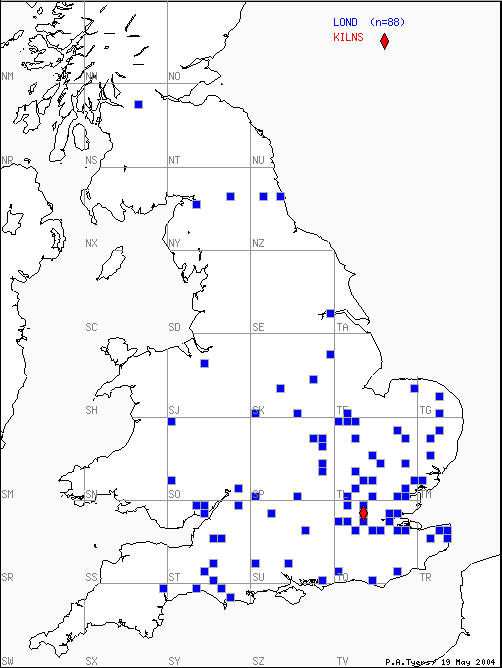
The style has a generally south-eastern distribution, and this is where most of the known producers are located.
Aliases
Carlisle fabric 319. Chelmsford fabric 33. JRPS bibliography fabric lnd. Milton Keynes fabric 15. Kent fine fabric 10b.
Bibliography
MacKenna 1978 for a survey of the London material and discussion of the background to the style. For Nene valley material: Perrin 1990. The ‘London ware’ decorative style is known on the continent, particularly in the Low Countries, where kilns are recorded at Cuijk: , 21-3.
References
**“.**
Holbrook and Bidwell 1991. Holbrook, N. and Bidwell, P. T., Roman finds from Exeter, Exeter Archaeological Reports, 4, Exeter City Council and the University of Exeter, Exeter, (1991).
MacKenna 1978. MacKenna, S. A., ‘Thin section report’ in Early finewares in Roman Britain, ed. P. Arthur and G. Marsh, BAR, 57, Tempvs Reparatvm, Oxford, (1978), p. 209.
Monaghan 1982. Monaghan, J., ‘An investigation of the Romano-British industry on the Upchurch Marshes’, ArchCant, 98, (1982), pp. 27-50.
Perrin 1990. Perrin, J. R., ‘Pottery of ’London Ware’ type from the Nene Valley’, Durobrivae, 8, (1990), pp. 8-10.