Fabric and technology
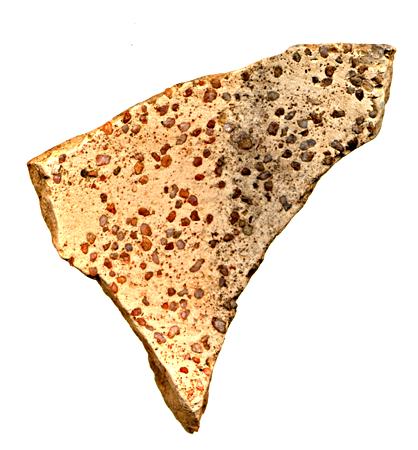
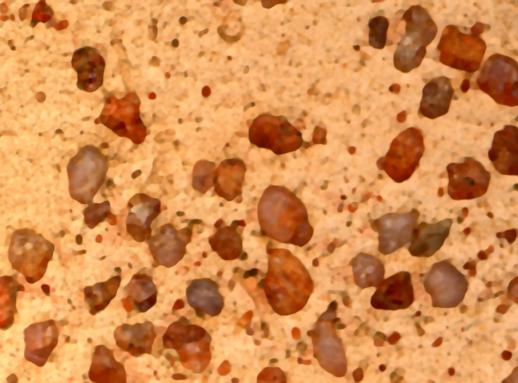
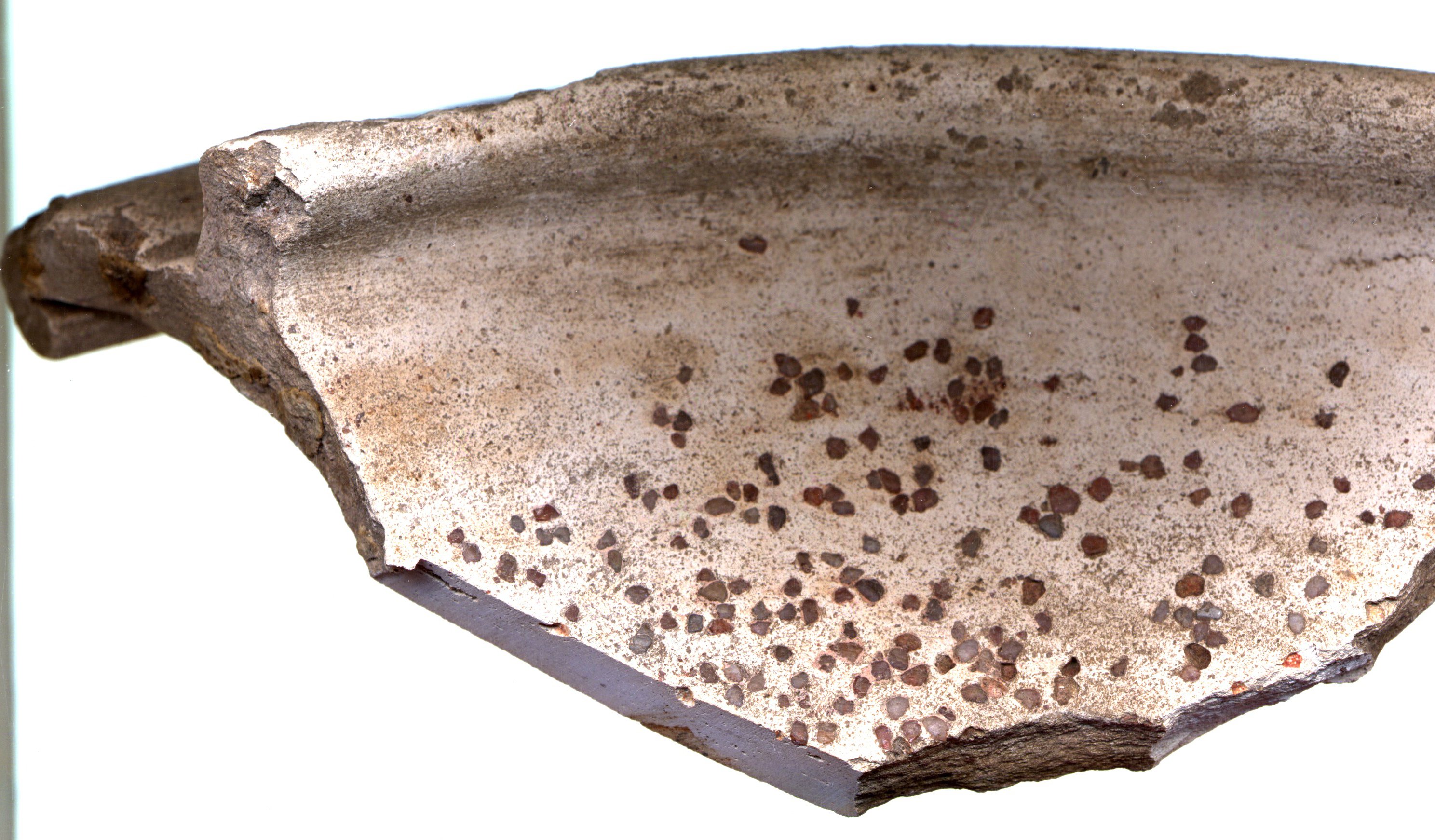
Hard, fairly fine-textured fabric; white, or cream, sometimes darker (light brownish-cream, with a pink core or with a cream to buff slip; some earlier fabrics contain abundant translucent quartz sand but most have a little red-stained quartz and occasional larger red and black inclusions; trituration grit invariably rounded translucent or transparent quartz – pink, black, white or brown. Wheel-thrown.
Forms
Mortaria, principally with bead and flange, but some wall-sided. Young defines 23 types (M1-M23) which cover the range (Young 1977, 56-79). Grooving on rim or flange common on later types (M17, M18, M22). Simple rosette, star or cross stamps on rare later 4th cent. type, M23; occasional red-painted decoration during 4th cent.
Stamps
Stamps or marks used during 2nd cent. but never common; principal named potter is Vossullus (c. AD 140-200). A pre-firing graffito from the Churchill Hospital site records a potter named Thamesubugus (/ 2496.4).
Chronology
Production from c. AD 100 until late-4th cent. The earliest forms of mortaria, and other early Oxfordshire products such as flagons, resemble those of the Verulamium region industry (VRMO) and production may originate with migrants from that area.
Source
The Oxfordshire potteries.
Distribution
Second cent. distribution largely confined to Oxfordshire and surrounding counties. Expansion from early- or mid-3rd cent. into London basin and Kent and (during 4th.) East Anglia and south-west. A scatter in Wales and the north.
Aliases
Bath fabric 2.1. Caister-on-sea fabric MOOX. Chelmsford fabric 25. Chesterfield fabrics m1 and m2. Chichester mortarium fabric 1. Colchester fabrics TK and TN. Dorchester fabric 19. Exeter mortarium fabric FB1. Gestingthorpe mortarium fabric P. Gloucester fabrics TF9A and TF9W. Great Chesterford mortarium fabric 1. JRPS bibliography fabrics oxm, oxwm and oxw mort. Leicester fabric MO1. Lullingstone fabric 35. Milton Keynes fabrics 4a, 4ba and 4ag. Old Penrith fabric 112. Kent mortarium fabrics 9a and 9b. Sidbury fabric 33. Towcester mortarium fabric 6. Usk mortarium fabric 15.
Bibliography
Young 1977; for stamps Hartley and Richards 1965, 37; Green 1983.: RCHM gazetteer 102-4, F561-73
References
Green 1983. Green, L. S., ‘The Roman pottery manufacturing site at Between Towns Road, Cowley, Oxford’, Oxoniensia, 48, (1983), pp. 1-11.
Hartley and Richards 1965. Hartley, K. F. and Richards, E. E., ‘Spectrographic analysis of some Romano-British mortaria’, BInstArch, 5, (1965), pp. 25-44.
Young 1977. Young, C. J., The Roman pottery industry of the Oxford region, British archaeological reports, 43, Oxford, (1977).