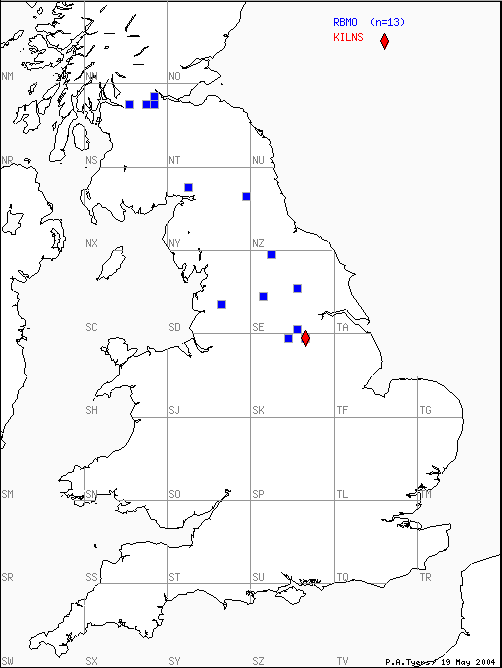
Fabric and technology
Hard, sandy fabric, usually orange-brown with grey core; abundant quartz sand tempering, with occasional red-brown and grey particles; mixed trituration grit, including haematite, quartz, and some flint and brown sandstone.
Forms
Mortaria with bead and rolled flange.
Stamps
The principal potter Rossington Bridge potter is Sarrius, who had earlier worked at Mancetter-Hartshill. Some Rossington Bridge mortaria are stamped jointly by Sarrius and either Setibogius or Secundua. The latest work of Sarrius seems to be at Mancetter-Hartshill, so the Rossington Bridge production may have closed down during his lifetime. The potter Baro may be related to the Baro of the Colchester workshops.
| Potter | Date | |
|---|---|---|
| BARO | 140-190 | <- COMO ? |
| SARRIUS | 135-170 | <- MHMO |
| SECUNDUA | 140-170 | |
| SETIBOGIUS | 140-170 |
Table 1. Principal Rossington Bridge mortarium potters
Chronology
Antonine.
Source
Rossington Bridge, near Doncaster.
Distribution
Northern Britain, including the Antonine Wall.
Aliases
Doncaster mortarium fabric 1. JRPS bibliography fabric rsm.
Bibliography
For the kilns see Swan 1984; discussions of Sarrius in MacIvor et al. 1981, 260; Buckland and Magilton 1986, 148.
References
Buckland and Magilton 1986. Buckland, P. C. and Magilton, J. R., The archaeology of Doncaster, 1. The Roman civil settlement, British archaeological reports. British series, 148, Oxford, (1986).
MacIvor et al. 1981. MacIvor, I., Thomas, M. C. and Breeze, D. J., ‘Excavations on the Antonine Wall fort of Rough Castle, Stirlingshire, 1957-61’, PSAS, 110, (1981), pp. 230-85.
Swan 1984. Swan, V. G. in The pottery kilns of Roman Britain, RCHM Supplementary Series, 5, RCHM, (1984).