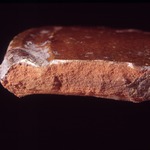
Fabric and technology
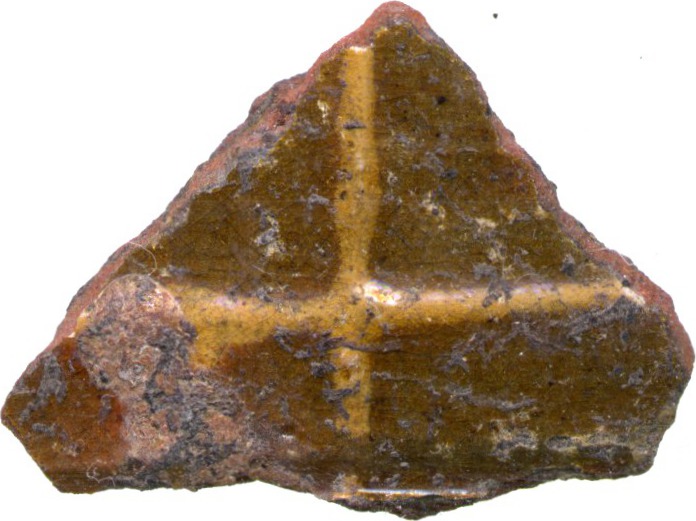
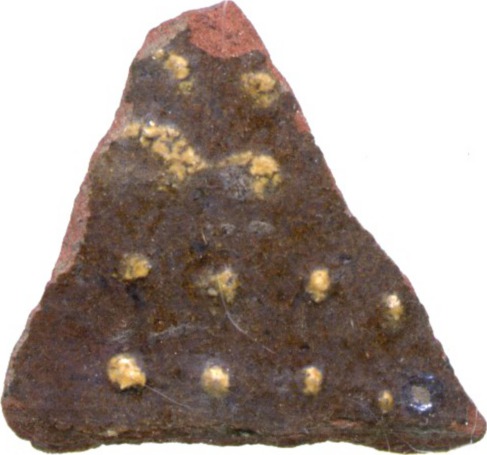
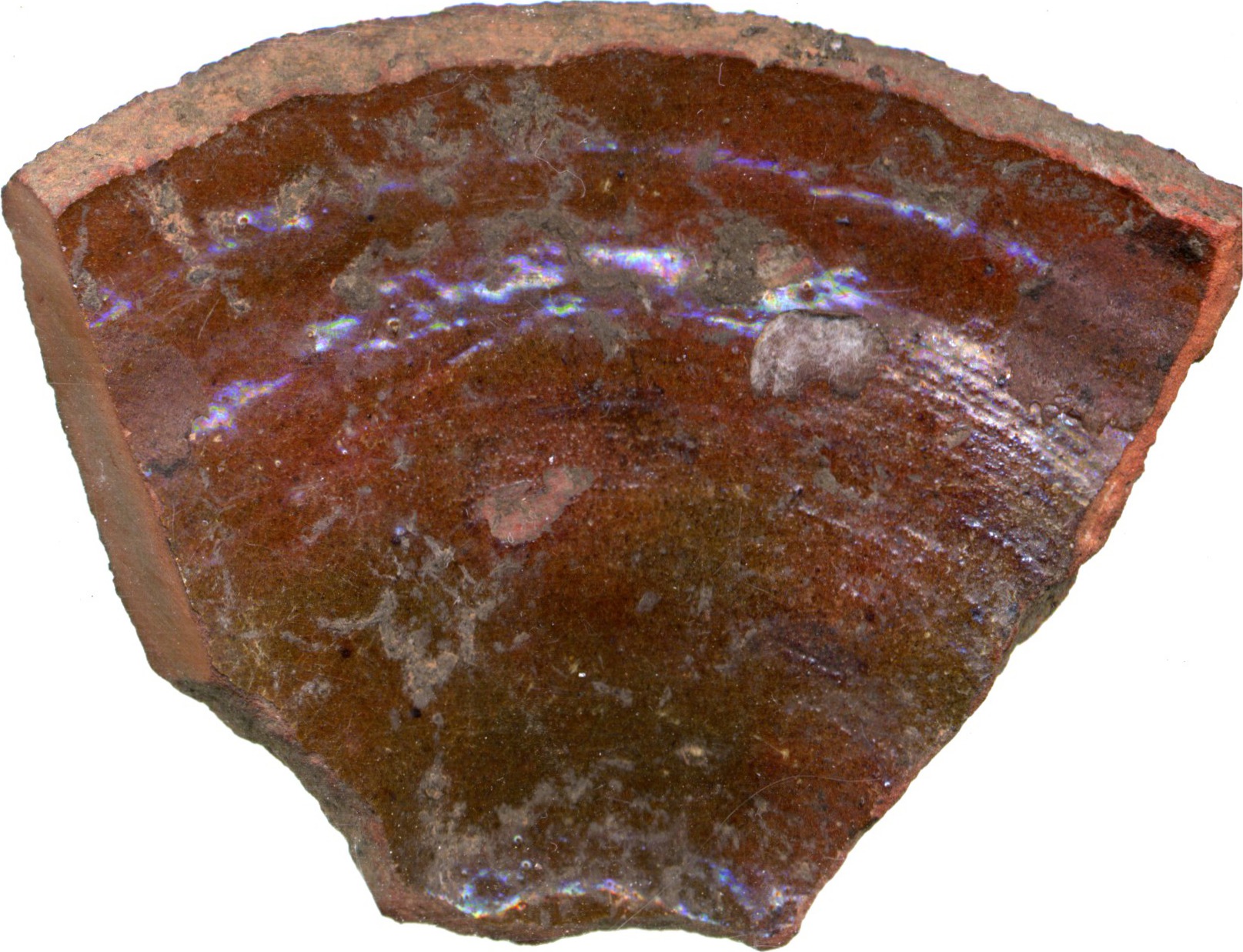
Hard fine fabric; usually grey but occasionally with red-brown margins; silty matrix, slightly micaceous, with occasional iron-rich pellets and mica; surfaces covered with translucent dark green glaze (e.g. 5YR 4/2-4) which may be over white clay barbotine decoration (which appears light-green or yellow through glaze). Wheel-thrown.
Forms
Arthur (1978) identifies 5 principal forms:
| Form | Description | Prototype |
|---|---|---|
| 1 | Pear-shaped flask | |
| 2 | Globular beaker with angular shoulder | |
| 3 | Globular beaker with everted rim | |
| 5 | Cylindrical bowl | (Drag. 30) |
| 7 | Hemispherical bowl | (Drag. 37) |
Table 1. Classification of South-east English glazed ware forms (after
Arthur)" The imitation samian forms are the most common. Decorative motifs include rows of barbotine circles, lattice, lozenges, dots and vertical lines or hairpins.
Chronology
Principally AD 70-120.
Source
The large quantities of the ware at Staines suggest one source (see RCHM gazetteer F487 for details).
Distribution
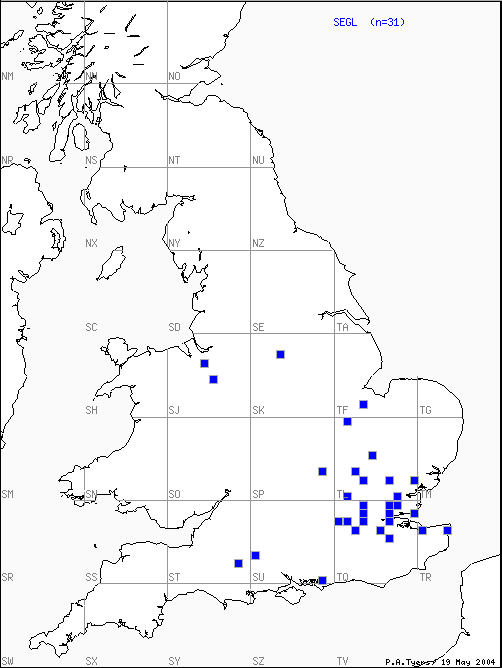
Principally the London basin and surrounding counties, with outliers in western Britain.
Aliases
Chelmsford fabric 10. Lullingstone fabric 1. Milton Keynes fabric 13a. Kent fine fabric 22.
Bibliography
Arthur 1978, 298-311.
References
Arthur 1978. Arthur, P. R., ‘The lead-glazed wares of Roman Britain’ in Early Fine wares in Roman Britain, ed. G. D. Marsh and P. R. Arthur, British archaeological reports. British series, 57, BAR, Oxford, (1978), pp. 293-356.