Fabric and technology
Soft, lumpy fabric, often with powdery texture; pink (5YR 7/4) or yellow-red (5YR 7/6) with distinct grey core; abundant angular grog inclusions, with some quartz, limestone and occasional flint and sandstone in slightly micaceous matrix. Wheel-thrown. Commonly smoothly burnished outer surfaces.
Forms
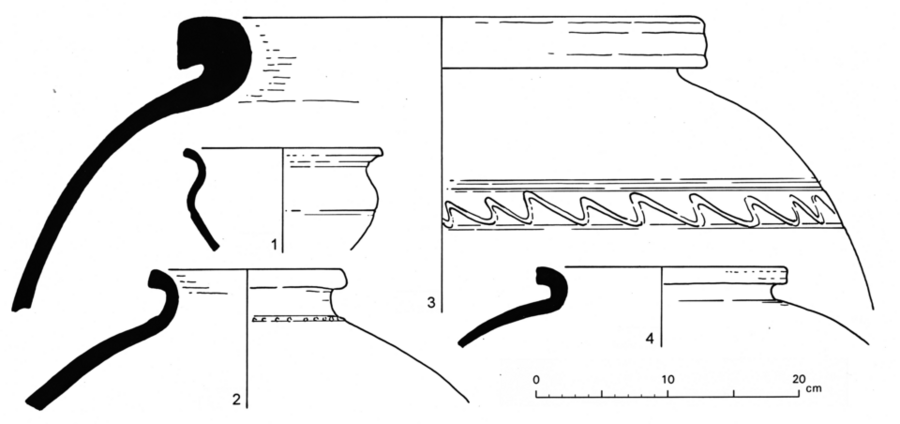
A wide range of jar, bowl and beaker types, but jars (and particularly large storage jars) are the most widely distributed types.
Chronology
Production of fabric may commence by late 1st cent. AD, but major increase from mid-late 2nd. Greatest distribution probably later 3rd/4th cent.
Source
High concentrations in Milton Keynes/Towcester region, and petrology, suggests production in Ouzel valley (nr. Milton Keynes).
Distribution
Very abundant on Bucks/Northants border (> 30% of assemblages at Milton Keynes and Towcester), but wide, thin spread (principally of storage jars) across West Midlands towards Severn Valley, with odd outliers at Cramond on Antonine Wall (Ford 1991). Booth and Green (Booth and Green 1989, 82) suggest that wide distribution of large storage jars indicates use as container.
Aliases
JRPS bibliography fabric pkg. Leicester fabric GT3. Milton Keynes fabric 2. Towcester fabric 35b.
Bibliography
Booth and Green 1989; Marney 1989, 64-9.
References
Booth and Green 1989. Booth, P. M. and Green, S., ‘The Nature and Distribution of Certain Pink, Grog Tempered Vessels’, Journal of Roman Pottery Studies, 2, (1989), pp. 77-84.
Ford 1991. Ford, B., ‘Two vessels in Pink Grog tempered ware from the Roman fort at Cramond, Scotland’, JRPS, 4, (1991), pp. 55-6.
Marney 1989. Marney, P. T., Roman and Belgic pottery from excavations in Milton Keynes, 1972-1982, Buckinghamshire Archaeological Society. Monograph, 2, Buckinghamshire Archaeological Society, Aylesbury, (1989).