Fabric and technology
Details of fabrics and finish vary with precise source and date. The products of major kilns are described below, but there are vessels on the British list from a number of other sources.
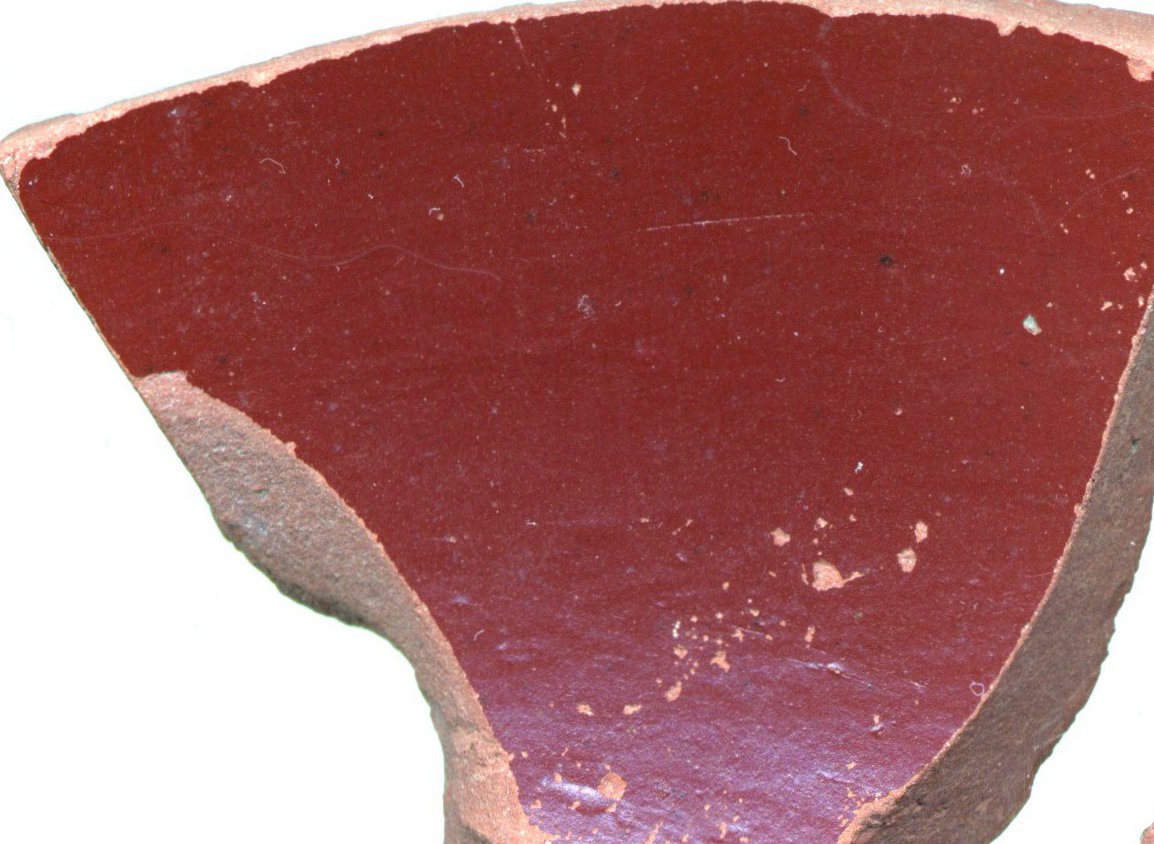
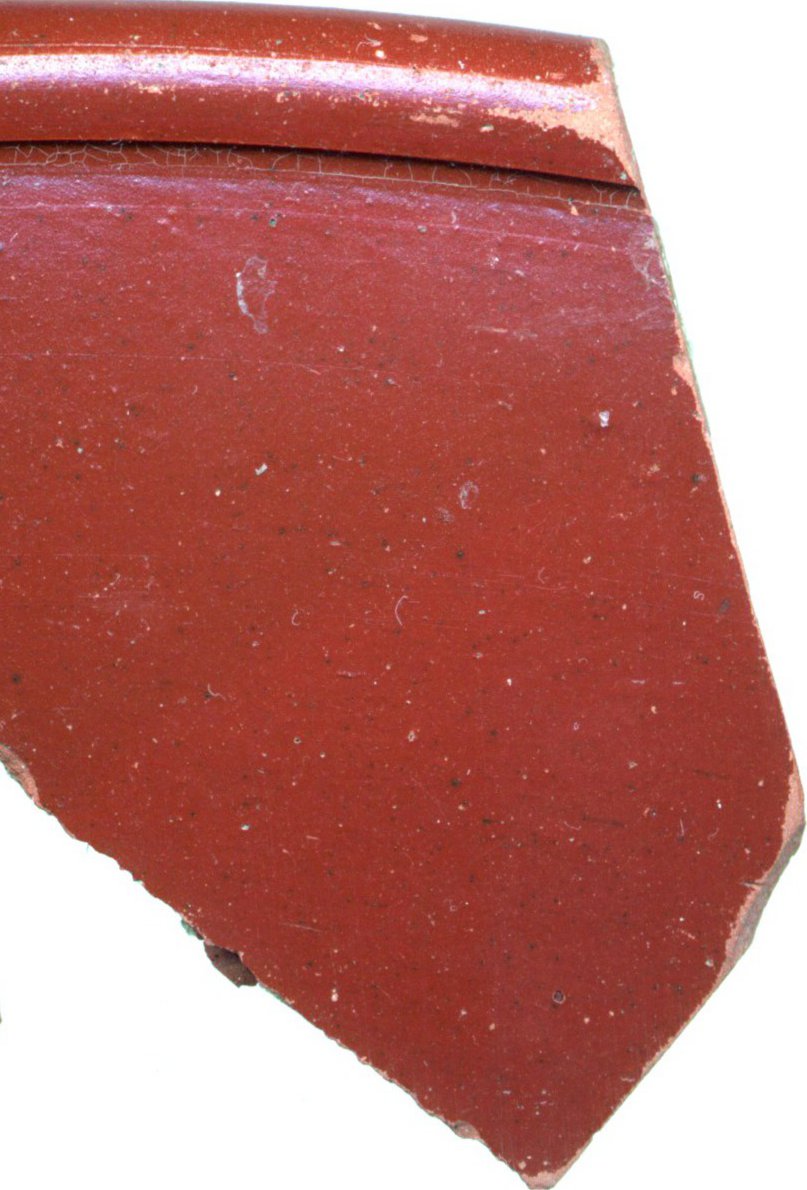
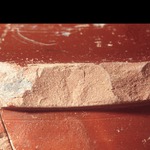
Trier: Products of Antonine period and early 3rd cent. resemble contemporary Lezoux ware in both colour and quality, but lack the distinct mica and may be densely chalk-filled, especially on larger forms. Later wares (of early to mid-3rd cent.) are pale, often pink or yellowish with relatively coarse thick fabric and uneven, rough-textured orange-red slip.
Rheinzabern: Earlier ware (Antonine to early 3rd cent.) is generally red or orange-red with sparse inclusions and faint swirl marks in the slip. By mid-3rd cent. a coarser, thick pale red or yellowish fabric with a thin, slightly glossy light-orange slip.
Argonne: Tend to be rather orange or orange-red in colour with a pinkish core and a fine gloss (very similar to the later roller-stamped products of the region: see ARGO).
Chronology
Production established by mid-1st cent. and increasing from c. AD 80. Significant export to Britain from c. AD 120 until 260. Products of La Madeleine, Heiligenberg, Blickweiler, Chémery and other small sites were imported during Hadrianic and early-Antonine periods (Marsh 1981, 181; Hartley 1972, 31), and some Argonne wares from c. AD 150 until 200, but Rheinzabern and Trier dominate from later 2nd cent. The study (and dating) of the latest decorated wares from both Trier and Rheinzabern is slightly complicated by the reuse of moulds from earlier phases of production on these sites, although these should be distinguishable from the earlier products by their fabric and details of form, such as the tall flaring rims and thick square footrings.
Source
Eastern Gaul; with major kiln sites in the Argonne Forest, through the Moselle region, and into Rhine valley.
Distribution
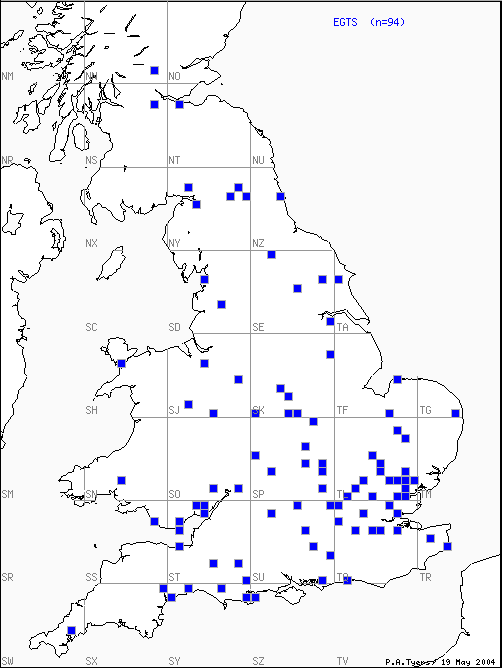
Rhineland, eastern Gaul and Danube provinces; in Britain, throughout, but sparser in west, with largest assemblages from south-east.
Aliases
Colchester fabric EG. JRPS bibliography fabric ets. Milton Keynes fabric . Kent fine fabric 5c.
Bibliography
Bémont and Jacob 1986, 195-263, with refs. For earlier production sites and dating: Lutz 1966; Lutz 1975; for Rheinzabern: Ludowici 1927; Ludowici and Ricken 1948; Ricken and Fischer 1963; Bittner 1986; for Trier: Huld-Zetsche 1971a; 1971b; 1972; 1993; the important ‘shipment’ group of East Gaulish material from New Fresh Wharf, London is described in Bird 1986; for a valuable summary of Rheinzabern and Trier wares in Britain: Bird 1995.
References
Bémont and Jacob 1986. Bémont, C. and Jacob, J.-P., La Terre sigillée gallo-romaine. Lieux de production du Haut Empire: implantations, produits, relations, Documents d’archéologie française, 6, Maison des Sciences de l’Homme, Paris, (1986).
Bird 1986. Bird, J., ‘Samian wares’ in The Roman Quay at St Magnus House, London, ed. L. Miller, J. Schofield and M. Rhodes, Special Paper, 8, London and Middlesex Archaeological Society, London, (1986), pp. 139-85.
Bird 1995. Bird, J., ‘3rd-century samian ware in Britain’, JRPS, 6, (1995), pp. 1-14.
Bittner 1986. Bittner, F. K., ‘Zur Fortsetzung der Diskussion um die Chronologie der Rheinzaberner Relieftöpfer’, BayVgBl, 51, (1986), pp. 233-59.
Hartley 1972. Hartley, B. R., ‘The Roman occupation of Scotland. The evidence of samian ware’, Britannia, 3, (1972), pp. 1-55.
Huld-Zetsche 1971a. Huld-Zetsche, I., ‘Glatte Sigillaten des ’Massenfundes’ aus Trier’, ReiCretActa, 13, (1971), pp. 21-39.
Huld-Zetsche 1971b. Huld-Zetsche, I., ‘Zum Forschungsstand über Trierer Reliefsigillaten’, TrZ, 34, (1971), pp. 233-45.
Huld-Zetsche 1972. Huld-Zetsche, I., Trierer Reliefsigillata: Werkstatt I, Materialien zur römisch-germanischen Keramik, 9, R. Habelt, Bonn, (1972).
Huld-Zetsche 1993. Huld-Zetsche, I., Trierer Reliefsigillata: Werkstatt II, Materialien zur römisch-germanischen Keramik, 12, R. Habelt, Bonn, (1993).
Ludowici 1927. Ludowici, W., Stempel-Namen und Bilder römischer Töpfer, Legions-Ziegel-Stempel, Formen von Sigillata- und anderen Gefassen aus meinen Ausgrabungen in Rheinzabern 1901-1914, Katalog, 5, Carl Ludowici, Speyer, (1927).
Ludowici and Ricken 1948. Ludowici, W. and Ricken, H., Die Bilderschüsseln der römischen Töpfer von Rheinzabern: Tafelband, Katalog, 6, Speyer, (1948).
Lutz 1966. Lutz, M., ‘Etat actuel de nos connaissances sur la céramique sigillée de la Gaule de l’Est’, RACFr, 5, (1966), pp. 130-57.
Lutz 1975. Lutz, M., ‘La puissance attractive de l’Est’, DosArch, 9, (1975), pp. 51-8.
Marsh 1981. Marsh, G. D., ‘London’s samian supply and its relationship to the development of the Gallic samian industry’ in Roman Pottery research in Britain and North-West Europe. Papers presented to Graham Webster, ed. A. C. Anderson and A. S. Anderson, British archaeological reports. International series, 123, BAR, Oxford, (1981), pp. 173-238.
Ricken and Fischer 1963. Ricken, H. and Fischer, C., Die Bilderschusseln der römischen Töpfer von Rheinzabern: Textband mit Typenbildern zu Katalog VI der Ausgrabungen von Wilhelm Ludowici in Rheinzabern 1901-1914, Materialien zur römisch-germanischen Keramik, 7, Habelt, Bonn, (1963).