| Levroux |
The site of Levroux
is one of the better known,
or at least better publicised,
Late Iron Age sites in Central France
(see summary by
Collis 1975, 194).
The earlier settlement is in the valley
at the Arènes site,
but this is succeeded by the hill-top
murus Gallicus
site -- referred to as `la colline'
in the literature.
The assemblage from Arènes
includes a number of Dressel 1a,
and a few sherds of Campanian ware.
There are Dressel 1b from `la colline'
and occupation probably continues up to at
least the end of the first century BC.
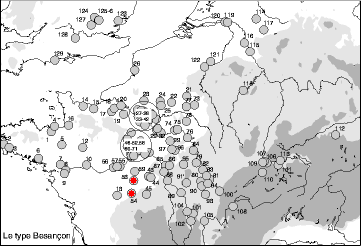
Ferdière records le type Besançon
from Levroux
in his 1972 catalogue
(Ferdière 1972, 80, site. 9).
The coarse ware jars from the Arènes site are very distinctive.
Some have light mouldings on the inner face of the rim,
but do not match the typology of the TF1 series in detail,
but their fabric is particularly characteristic --
it is hand-made,
dark brown or orange-brown and usually with a
black slip over the rim and shoulder.
This ware is abundantly tempered with white-mica
and contains large rock-fragments
In thin-section
the latter have been identified as schists.
This is clearly not TF1,
nor related in any way.
The `fresh' appearance of the schist fragments
may suggest that they were not been transported far from
their source -- an origin to the south,
in the Massif Central,
may be provisionally suggested.
Further investigation of this ware will certainly be of value,
concentrating on the determination of its source,
distribution and date.
Moulded-rim jars occur in small numbers at `la colline'.
A few,
principally the larger jars of class 1 are in TF1,
but the majority,
which match the form of
Cam.262,
are in a different fabric
Another aspect of the Levroux ceramics
is reported by
Coulon and Odiot (1980)
in their study of the material from the kilns at Villedieu-sur-Indre,
some 30km to the south-east.
They investigate the relationship
between the clays employed for pottery and kiln construction
and the geological deposits in the immediate area of the site,
concluding that the pottery is manufactured from
two different local clays.
One of these,
class A (derived from the recent alluvium of the Indre),
is apparently present at Levroux where it comprises 5% of the assemblage
(ibid.,
92 -
It is not clear whether this value describes at the Arènes or `la colline',
or both).
The exact associations and
chronology of the moulded-rim jars must await the
final publication of the finds from these sites but the
sequence of developments
relevant to the history of TF1
can be summarised as follows:
-
There is no evidence of TF1 at the earlier Arènes site
but one of the principal wares may originate to the south.
-
There are a few examples of TF1 from the `la colline'
but the majority of vessels assigned to le type Besançon
are not TF1.
|
| Saint-Marcel |
Moulded-rim jars of form C262 are
common amongst the early Roman
pottery published from Argentomagus.
Those from the pit on the `Fontaine' site
(Albert 1972)
are associated with samian
forms Drag. 17,
Drag. 24/25
and Ritterling 12,
probably of Tiberian date.
The `Vergobret' pit published
by Allain, Fleuriot and Chaix (1981)
is earlier,
and the assemblage
includes Aco-beakers
and other early-Roman fine wares,
including
sigillata.
One vessel has an
Ateius stamp
and another Atepomarus of Lezoux.
Analysis of petrological samples suggests that
the majority of the micaceous jars
from Argentomagus are in TF1.
In the selection illustrated on Fig.12,
nos 6-10 and 12-16 are in TF1,
but no.11 is in a finer wheel-thrown ware,
perhaps related to the jars of
Cam.
type 102 from Orléans and elsewhere.
|