|
|
Camulodunum type 262, le type Besançon and Central Gaulish granite-tempered ware
Summary of distribution in département 45-Loiret (France)
Click on the site name for more details
| Site name |
Description |
| Artenay |
Unpublished information supplied to A. Ferdière.
|
| Beaugency |
Ferdière records several examples of le type Besançon
from an early Roman site at Beaugency.
|
| Lion-en-Beauce |
Unpublished information supplied to A. Ferdière.
|
| Meung-sur-Loire |
The assemblage recovered during rescue
excavations at `Le Caillou',
Meung-sur-Loire,
includes Dressel 1a and 1b amphoras
and a jar of le type Besançon.
The fabric of the jar is not described.
It has a band of incised decoration on the shoulder,
although the form resembles the C262, which is normally plain.
|
| Orléans |
The Augustan and later occupation at Orléans is extensive
but it was only in 1984 that an earlier sequence was recovered
at Îlot Saint-Germain,
in the centre of the Roman and medieval city
(Orléans site O18; excavations directed by D.Petit for the
Direction Regionale des Antiquites Historiques du Centre region;
see Ferdière 1985 for a note on the excavation).
A selection of material from the site has been illustrated
in an exhibition catalogue published by the Musée de Châteaudun
(Villes ed. 1985, 71-72, fig.45).
The ceramics from the lowest levels
include fine painted wares of the early `vase balustre' style,
Dressel 1a amphoras and Campanian ware.
The coarse wares are rather plain and
confined to simple necked jars and open bowls --
there is no sign of any moulded-rim style,
either in TF1 or other wares.
Large jars of class 1 (apparently) in TF1 only appear in higher
levels and are succeeded by deposits containing
smaller jars of the
Cam.262
type associated with flagons,
samian and other early Roman fine wares.
This sequence is important as
it demonstrates a stratigraphic relationship between an indigenous
coarse ware tradition and the appearance of TF1.
With further study we may even be able to place a
terminus post quem
on the arrival of TF1 in the region.
Moulded-rim jars,
including many in TF1,
are undoubtedly very common at Orléans and elsewhere in the region,
but we should look to the coarse wares from the lowest levels of
the Îlot Saint-Germain sequence to illustrate the indigenous tradition
that has been displaced.
Moulded-rim jars in fabrics TF1, TF2 and the `Standard fabric', including forms
Cam.262,
Cam.102,
bowls
and larger dolia-type vessels are
common in Augustan and Tiberian contexts at Orléans.
|
| Saint-Aignan-des-Gués |
Ferdière illustrates a large jar of our class 1
from an early `fossé gauloise'
at Saint-Aignan-des-Gués -
he records that there are several examples,
mostly decorated with chevrons or oblique incisions
on the shoulder.
The published photograph
(Ferdière 1972, fig.3)
may suggest that these vessels are in TF1.
|
| Tavers |
Ferdière records several examples of le type Besançon
from Tavers.
|
| Vienne-en-Val |
Ferdière illustrates an example of le type Besançon
from an Augustan assemblage at Vienne-en-Val.
It is an undecorated example of our class 1.
|
|
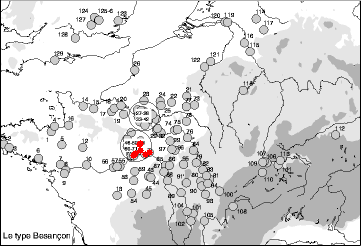 Location map : 45-Loiret (France)
|
|