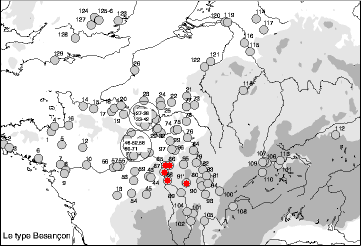
| Mont Beuvray |
The excavations at Bibracte between 1867 and 1907 recovered
a group of material which continues to play a significant rôle
in La Tène archaeology in France.
The material from the early excavations is
somewhat dispersed.
The largest groups are at the
Musée Rolin in Autun and the
Musée des Antiquites Nationales, St.Germain-en-Laye (Paris),
but there is also a small collection in the Musée Déchelette,
Roanne.
Although chosen by Déchelette as the type site for his
La Tène III period it has long been clear that a proportion
of the assemblage belongs not to the period of Gallic independance,
but rather to the decades between 50 BC and the foundation of Autun
under Augustus.
The series of excavations which commenced in 1985 should
provide a sequence of assemblages against which the material from
the older investigations can be compared,
enabling the site to be placed in its proper regional context.
A preliminary report on the 1984-5 campaign
(Beck el al. 1987)
includes illustrations of several moulded-rim jars
(fig.6, 1,3,7,8. fig.7, 5,7,10)
which are described as `.. bords moulurés
plus ou moins déjétes vers l`extérieur,
pâte à gros degraissant .. '
-- Ferdière's 1972 article is cited as a parallel.
A more detailed description of the fabric of these vessels
would be more than welcome.
The only substantial publication of the
ceramics from the older excavations is
Thiollier's Album of 1899
(with some additions and corrections by
Cabotse and Périchon 1963
and Périchon 1966),
which naturally falls somewhat short of modern standards.
The material includes jars in TF1,
particularly the
Cam.262
and related jars
and large jars of class 1
Some vessels are clearly related in form
although the fabrics are different
(e.g. FIG.14, 6,8,11)
whilst others,
such as jars with combed decoration
belong to a separate tradition,
but clearly still within the general moulded-rim style.
Although the extant Bibracte material may not be fully representative
(and only comparison with the material from the new
excavations will reveal this),
it is reasonably clear that TF1 is a major component of
the coarse ware assemblage on the site.
|