|
|
Camulodunum type 262, le type Besançon and Central Gaulish granite-tempered ware
Summary of distribution in département 77-Seine-et-Marne (France)
Click on the site name for more details
| Site name |
Description |
| Chelles |
One example of a dolia of le type Besançon in a micaceous
fabric from a context dated c.30-20BC.
|
| Melun |
There are a large number of C262 jars and larger vessels of our class 1
(usually undecorated)
in TF1 from Augustan assemblges at Melun,
but they are superceded in Claudian and later levels
by grey-ware moulded-rim jars.
These are similar in form to the earlier C262 type
but usually have a single internal groove
rather than the double or triple grooves of the earlier types.
The grey-ware variety seems to continue in use
until at least the later second century AD and
it is suggested that some at least were produced
at the Villeneuve-au-Châtelot kiln site,
some 70km to the east
(information from Mme Cottart, Melun).
Jobelet and Vermeersch cite examples of dolia, jars and bowls
of le type Besançon from Melun (published in a local museum catalogue)
dated Augustan-mid first century AD.
|
| Montereau |
Examples of le type Besançon from Montereau,
cited by Bulard and Drouhot (1981, 363 note 4).
|
| Pamfou |
Ferdière records examples of le type Besançon from
early Roman levels at Pamfou.
|
| Saint-Germain-Laxis |
Several examples of jars and bowls
of le type Besançon from Augustan-Claudian contexts.
|
| Vaires-sur-Marne |
A most interesting Late La Tène site
at Vaires-sur-Marne (Seine-et-Marne;
is reported by
Bulard and Drouhot (1981).
The site lies on the banks of the Marne,
some 22 km east of Paris.
The ceramics includes a number of Dressel 1a amphoras
(ibid.,
fig.14)
and two small cups which are described as `imitations'
of the Campanian form B1
(ibid.,
fig.8, 13-14).
There is also a complete jar of class 1
with incised decoration on the shoulder
(ibid.,
fig.10, 1)
the fabric is described as
containing `... un dégraissant siliceux
de gros calibre avec adjonction de fines paillettes de mica jaune'.
The reference to `large inclusions' is suggestive
and we might speculate that they are in fact feldspars --
perhaps this is an example of TF1.
The jar,
one of the few complete published examples of class 1,
has a diameter at the mouth
of 21 cm and is 24 cm in height.
Two further vessels are
distinguished which have central Gaulish
parallels --
tall conical jar necks with burnished wavy-line
decoration in fine grey wheel thrown fabrics
(ibid.,
fig.8, 18-19;
citing, from Roanne,
Bessou 1976, pl.45,1-2).
This rich assemblage,
which also includes a fine range of local coarse wares,
is convincing evidence for the
pre-conquest circulation of moulded-rim jars (and TF1?)
in Northern France.
|
|
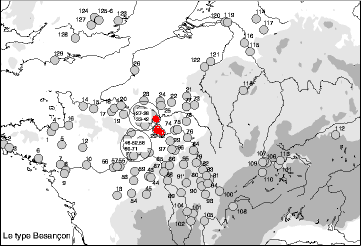 Location map : 77-Seine-et-Marne (France)
|
|