  | Site name |
Corseul |
| location |
FR 22-Côtes-du-Nord |
| museum |
|
| Typology |
Cam 262? |
| Description |
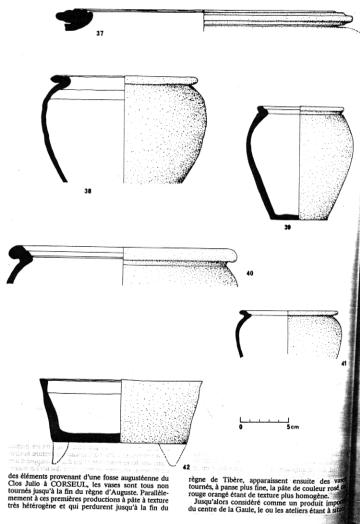
Fichet de Clairefontaine (1986)
illustrates several vessels of the C262 form (figs.38-41),
an example of our class 1 (fig.37)
and a moulded-rim bowl (fig. 42).
It is suggested that some of these vessels are
products of industries outside the immediate area (figs.37-39)
whilst others are in `local' fabrics,
either sand-tempered (fig.40)
or made from a clay bearing silicaceous
spicules from fossil sponges (fig.41).
The latter wares are discussed further by
Giot and Querre (1986).
The principal outcrops of the clays containing these
spicules are concentrated in southern Brittany,
with smaller outcrops on the Normandy peninsular
(
ibid.,
fig.2)
and they are exploited intermittently from the
Bronze Age until the present century.
During the early Roman period the ware is known on a number
of sites in the valley of the Vilaine,
Alet on the north coast and also further west.
At Corseul it is suggested that the moulded-rim jars in the
spicule-tempered wares are preceded
by examples in micaceous fabrics
and judging by the published descriptions some of the latter
may be TF1.
|
| Ferdière 1972 |
|
| Bibliography |
Langouet 1978, 65
Fichet de Clairefontaine 1986
sfecag mans 1997
sfecag cognac 1991 |
| Fabrics(s) |
Insufficient data |
|
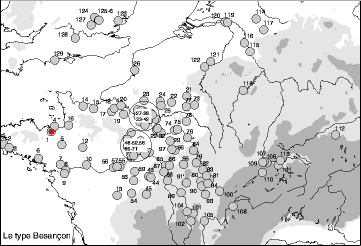 Location map : Corseul
   Additional illustrations, notes and text
|