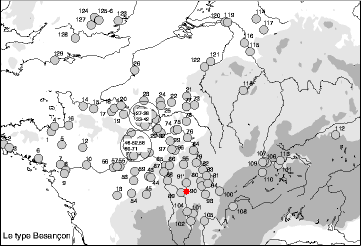
| Description |
The La Tène III coarse wares
from Mont Dardon are `characterized
by [a] perpendicular,
grooved rim,
usually with a single row of incisions or punctuations
around the neck and shoulder,
and a high degree of micaceous temper'.
The early Roman material (classed as
précoce)
is described in similar terms
and the moulding of the inner face of the rim
is picked out as a particularly distinctive feature.
Ferdière's 1972 article and the
assemblage from Tournus
are cited as parallels.
One of the illustrated jars from the site
(Green
et.
Fig.17,b)
matches the C262 form,
but others (Fig.17,a,c)
differ.
The general description of the wares
(`.. reddish-brown to black .. coarse pastes containing
large amounts of temper.')
is lacking in critical detail.
It is claimed that the majority of the ceramics in the
Gallo-romaine précoce levels on the site
(and a proportion of the earlier material as well)
is the product of kilns at Guegnon,
some 8 km to the south
(
ibid.,
77-8; citing Notet 1984).
Guegnon is perhaps better known
as a producer of samian and related
fine wares in the 2nd century AD
(Notet in Bémont and Jacob 1986, 166-71),
but earlier production is claimed.
Given this attribution of the Mont Dardon material
it is particularly unfortunate that the fabrics are not adequately described.
We cannot be sure whether the jars in question are
in TF1 or one of the other wares known to be in circulation.
Although the site has yielded amphoras,
perhaps including Dressel 1
(Green
et.
Fig.17, f-g),
and Campanian ware cups
(ibid.,
Fig.17, d-e)
it seems that the majority of the moulded-rim
jars are from levels associated with early Roman fine wares
including samian.
|