| Description |
East of Châlon,
near the confluence of the Saône
and the Doubs lies the Late La Tène site of Petit Chauvort
at Verdun-sur-le-Doubs
The pottery includes Dressel 1a amphoras,
a surprisingly large quantity of Campanian A
(Vaussanvin 1978, 141-4. Pl.2, 1-8)
and early varieties of painted ware
(Guillot l97l; Périchon 1985).
The site is clearly pre-Caesarian and Morel
has commented that the Campanian wares should be
assigned to the second century BC,
perhaps before 130 BC
(Morel 1978, 166).
Amongst the coarse wares
are a large number of large jars of class 1 and 2
in TF1
This is not,
however,
the only material of interest from the site.
The assemblage
also includes numbers of coarse ware
bowls with moulded rims.
These are not in TF1 and
have more affinities of both form and fabric
with the Tournus material.
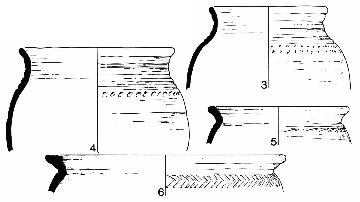
There are also two jars
with tall slightly out-turned
rims with horizontal ripples on the neck.
Both have a row of coarsely
impressed decoration on the shoulder,
granular,
sand-tempered fabrics and unevenly burnished surfaces
These ripple-necked jars are unrelated to
the moulded-rim jars of the Saône valley discussed above
and represent a separate and distinctive tradition.
It is not proposed to discuss this style in detail here --
it is sufficient to note affinities
with material from sites in the Rhône valley,
such as Vienne
(Chapotat 1970, pl.XLVII;
see Tyers 1981, 108-112 for a summary of the style) and
in all probability these vessels are products of an industry
in that area.
It is unfortunate that a final report on this
important and rich site is not yet available.
It is clearly of some importance for the chronology
of the early phase of TF1 production
to assess all the dating evidence in some detail.
The indications that the coarse ceramic assemblage
includes material from a number of sources
should caution against picking out any one
of them as the `local' product
(contra
Vaussanvin 1985, 124),
at least without taking account of the
detailed background of all the material.
It may be relevant to any interpretation
of this mixture of sources
that the site lies adjacent to the
confluence of the fast flowing River Doubs and the
calmer Saône.
The site would be an excellent transhipment point between
material coming from
the south and the north-east.
|