| Description |
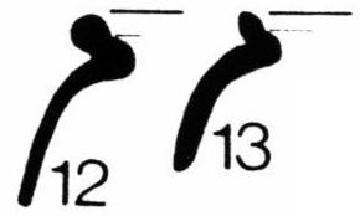
Coarse ware moulded-rim jars do not appear as
an individual type in Loeschcke's classic type-series but
two rim sherds,
illustrated in section only,
are certainly examples of the form C262
(FIG.16,12-13).
They are classed and discussed with
Haltern form 86 -
a fine beaker with barbotined herringbone decoration and
a mica-dusted shoulder zone -
although it is clear from the text that their relationship to
these finer wares was considered slight.
Loeschcke's original descriptions are as follows:
- a)
-
06.652 (Abb. 44,4) aus rötlichen Ton mit weissem Kern.
Lippe und Shulter sind rotgelb überstrichen und
tragen deutlich Glimmerreste. ..
- b)
-
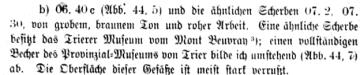
06.40c (Abb.44,5) und die ähnlichen Scherben 07.2, 07.30,
von grobem, braunem Ton und roher Arbeit. ..
In his discussion of group b),
Loeschcke cites,
and illustrates,
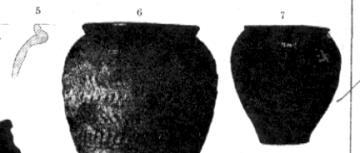
a complete jar from Trier and,
most helpfully,
notes a parallel amongst sherds from
Mont Beuvray,
then housed in Trier Museum
(Loeschcke 1909, 288).
An accompanying footnote
(ibid.,
note 3)
records further sherds
including an example from the Fürstenberg at Xanten,
but these do not seem to have been published elsewhere.
Loeschcke's citing of both the Mont Beuvray sherds
and the Trier vessel,
the latter in turn most
probably that noted by Hawkes and Hull (1947) as a parallel
for
Camulodunum
type 262,
leads us strongly to the conclusion that
the vessels of Loeschcke's group b) are in TF1.
Haltern was probably occupied between
c.
8BC and AD9
(Wells 1972, 188-191).
[dating 5BC to AD9 in
CVA2
(Oxe, Comfort & Kenrick 2000)].
|