| Description |
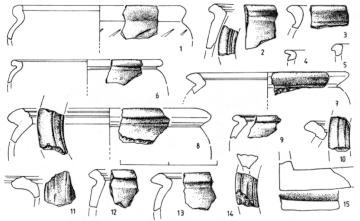
Ferdière illustrates three jars of form C262
from early Roman pits at `La Borde', Dambron.
(Ferdière 1976, fig.2, 2,8-9)
and described as coarse,
micaceous and hand-made.
These are associated with smaller finer
wheel-thrown jars,
similar to the C102 type (
ibid.,
fig.2, 10-11).
The groups also contain samian from La Graufesenque,
sherds of a vessel stamped by Ateius
and a selection of fine terra nigra cups and plates.
A Tiberian date seems most probable for
these groups.
The assemblage from `La Fosse Dieppe'
illustrated by Villes (1982)
is predominantly coarser wares of middle or
later La Tène date,
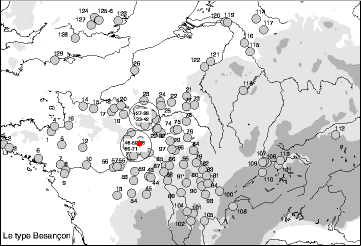
but there is a small group of le type Besançon
from the site.
Villes' fig.13 illustrates nine moulded-rim jars
in TF1 (nos. 1,2,4,5,7,8,9,11,13 -
nos. 2 and 12 are the same vessel; samples
B100,
B101)
and two in TF2 (nos. 6,14;
B103).
The TF1 jars are largely of the undecorated C262 form,
but one (no.1) has a band of incised lines on the shoulder.
Most of the other wares from Dambron,
presumably relatively local in source,
are brown or grey-brown in colour
and tempered with quartz,
calcite,
chert (?)
and calcite-rich clay pellets (
B106).
Villes suggests that the moulded-rim jars
belong to an early phase of the
production but the absence of either class 1 or 2
might weigh against this.
|